
Boiler Replacement Quotes for Radstock (BA3)
Boiler Replacement Quote covers a range of jobs, from straightforward like-for-like swaps to full system redesigns with new pipework, controls and hot water storage. The right approach depends on boiler location, flue length, pump speed, radiator sizing and how the property loses heat. As a Gas Safe and OFTEC registered firm and a Worcester Bosch Accredited Installer working out of Radstock, we specify each install against the building rather than fitting a standard package regardless of fit. Most of what we open up here is former mining terraces and post-war housing, which dictates flue routes and pipe sizing. Our van runs the A367 to reach you, 0 miles out from the Radstock workshop. In Radstock itself (BA3, Somerset) that usually means former mining terraces and post-war housing, roughly 0 miles from the workshop.
Boiler Replacement Quote — what you actually get
- Free written specification
- Conversions (regular → combi) costed honestly
- Smart controls (Nest, Hive, Tado) priced in
- Clean, tidy, dust-sheeted installs
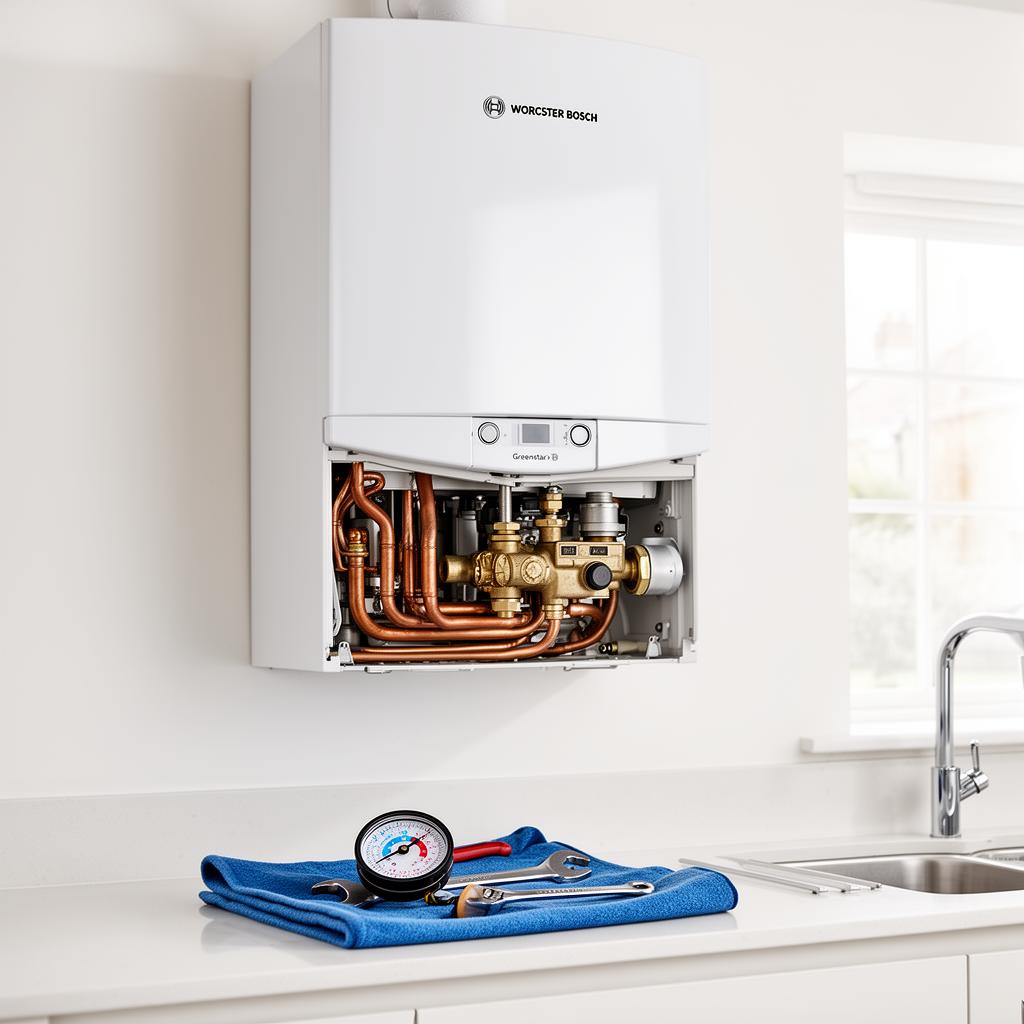
Water here runs off carboniferous limestone and Jurassic oolite, which makes it very hard by national standards. Hard water accelerates scale build-up inside heat exchangers, cylinders and pipework, which shortens the working life of components that aren't protected against it. On jobs in this area we factor scale protection into the specification rather than treating it as an optional extra, because the difference between a protected and unprotected system shows up within a few years, not decades. It's a genuine local variable, not generic sales advice, and it applies whether the property is on mains gas or oil. Nearest neighbours on our round are Midsomer Norton, Westfield, Clandown. Planning constraints are usually light here, so external work is checked first. Boiler replacements in Radstock are shaped by the property stock here — former mining terraces and post-war housing. We plan flue, condensate and controls around the building before we put a number on the page.
Within reach of the A367
We cover Radstock alongside Midsomer Norton (BA3), Westfield (BA3), Clandown (BA3), Welton (BA3) — so spares, follow-ups and annual visits are easy to schedule together.
Qualifications behind the work
We don't ask for money up front. Pay on completion when the system is signed off.
Boiler, controls, flue, warranty terms, flush spec — all in writing before you commit.
We're 24 Bristol Rd, Radstock — you'll deal with the same team for any aftercare.
Free, no-pressure 20-minute visit — measured up properly so the price is fixed, not estimated.
Reading the property before pricing the work
Water here runs off carboniferous limestone and Jurassic oolite, which makes it very hard by national standards. Hard water accelerates scale build-up inside heat exchangers, cylinders and pipework, which shortens the working life of components that aren't protected against it. On jobs in this area we factor scale protection into the specification rather than treating it as an optional extra, because the difference between a protected and unprotected system shows up within a few years, not decades. It's a genuine local variable, not generic sales advice, and it applies whether the property is on mains gas or oil. Nearest neighbours on our round are Midsomer Norton, Westfield, Clandown. Planning constraints are usually light here, so external work is checked first. Boiler replacements in Radstock are shaped by the property stock here — former mining terraces and post-war housing. We plan flue, condensate and controls around the building before we put a number on the page.
Why we visit before quoting — Radstock
- Confirm gas supply pipe size to the meter
- Plan flue route within building regs
- Check radiator sizing for the heat load
- Look at hot-water demand vs combi capacity
- Spot anything that'll affect the day-of price
Common queries, answered honestly
- How do you decide whether to repair or replace a boiler?
- We weigh the age of the boiler, whether parts are still made for it, how many faults it's had recently, and its running efficiency against a like-for-like or upgraded replacement. If a straightforward part fixes it and the boiler's otherwise sound, we'll say so rather than push a new install you don't need.
- What are your opening hours, and can you help out of hours?
- Our published hours are Monday to Friday, 8:30am to 5pm, and that's when the phones are answered and jobs are booked. We're honest that we don't run a round-the-clock emergency line, so if you're planning ahead, call during those hours on 07516 118198 and we'll get you booked in.
- What actually happens on install day?
- The engineer isolates the gas or oil supply and water, removes the old boiler, fits and pressure-tests the new one, connects the flue and condensate, and commissions the system. For a straight swap this is usually one day; a conversion, relocation, or cylinder change can run into a second depending on the pipework involved.
- Do I need to do anything to activate my boiler's warranty?
- As a Worcester Bosch Accredited Installer we register qualifying Worcester installs on your behalf, which is what unlocks the extended guarantee (up to 10 years* on qualifying installs) rather than the standard shorter term. For other brands we still register the installation; keep the confirmation with your other paperwork in case you need it.
- What's the difference between a power flush and a chemical flush?
- A chemical flush circulates a cleaning agent through the existing system to loosen light debris, while a power flush uses a pump to force water at higher velocity and reversed direction through radiators and pipework to shift heavier sludge. We usually recommend the more thorough power flush before connecting a new boiler to an older system.
- Will the new boiler work properly with our existing radiators?
- Not always without checking. Modern condensing boilers run most efficiently at lower flow temperatures, and radiators originally sized for an old, hotter-running boiler can end up struggling to heat a room adequately at those lower temperatures. We check radiator sizing against a heat loss calculation and flag any that are undersized for the room before installing.
Radstock coverage and distances
- County
- Somerset
- Postcode district
- BA3
- Settlement type
- town
- Nearest classified road
- A367
- Distance from our base
- 0 miles (Radstock, BA3)
- Typical building stock
- former mining terraces and post-war housing
- Water hardness
- very hard limestone water
- Fuel availability
- mains gas across most of the area
- Customer mix
- a mix of owner-occupied and rented homes
- Nearby areas covered
- Midsomer Norton, Westfield, Clandown, Welton
Practical considerations across BA3
What voids or protects a Worcester Bosch extended guarantee
Worcester Bosch's longer guarantee periods on qualifying installations are conditional on the boiler being installed and commissioned by an Accredited Installer, on an annual service being carried out (by any Gas Safe registered engineer, not necessarily the original installer) within the required window each year, and on system water quality being maintained to the standard set out in their published guidance — meaning a system flush at installation, correct inhibitor dosing, and in hard water areas a scale reducer or filter as specified. Missing a single annual service, or installing without the required water treatment, can reduce cover back to the manufacturer's standard guarantee period even if the boiler itself has had no faults. Keeping the Benchmark record and service history together is what lets a claim be assessed quickly if it's ever needed.
Radiator sizing after lowering the flow temperature
Running a boiler at a lower flow temperature — typically 55°C or below rather than the old default of 70-80°C — improves condensing efficiency measurably, but it also reduces the heat output of every radiator in the house, because a radiator's output falls roughly with the square of the temperature difference to the room. Radiators sized correctly for a 75°C flow can end up unable to heat the room properly at 55°C unless they're upsized or supplemented. We check each radiator against the lower design flow temperature before recommending it, and where a room falls short we look at whether a larger single panel, a double panel, or an additional radiator on that circuit closes the gap, rather than pushing the flow temperature back up and giving away the efficiency gain.
Pumped-oil versus gravity feed: does it matter?
Older oil systems sometimes still rely on gravity feed, where the tank sits higher than the burner and oil flows down to it under its own weight; a pumped system uses the burner's internal pump to draw oil up from a tank at any level, including below the boiler. Gravity feed limits where a tank can be sited and is more prone to airlocks if the line runs dry, while a pumped system is more flexible on tank position but needs the pipe run and lift height kept within the burner pump's rated capacity — usually no more than a few metres of lift and a set maximum run length. When we replace an oil boiler we check which type the existing tank and pipework support before assuming a straight swap, because a tank sited for gravity feed may need repositioning or a different pump to suit a modern burner.
How a condensing boiler recovers extra heat
A condensing boiler passes flue gases through a secondary heat exchanger before they leave the flue, extracting additional heat by condensing water vapour in the exhaust back into liquid, which is expelled as the mildly acidic condensate water down the drain. This is why every condensing boiler needs a condensate drainage route as part of its installation, unlike older non-condensing boilers, which simply vented hot dry gas straight out. The efficiency benefit only fully materialises when the boiler is actually condensing regularly, which needs a return water temperature low enough — generally below 55°C — for water vapour to condense in the first place. A condensing boiler run permanently at a high flow temperature can spend much of its time not actually condensing, which is one of the main reasons flow temperature settings matter as much as the boiler model chosen.
Working across Somerset: what being local changes
Being based at 24 Bristol Road, Radstock, 0 miles from Radstock via the A367, means a callout doesn't involve a long cross-county drive, and it also means familiarity with the recurring patterns in the local building stock — former mining terraces and post-war housing — rather than encountering that construction type for the first time on-site. Local knowledge doesn't replace a proper site survey, but it does mean fewer surprises: knowing in advance that a particular postcode area typically has hard water, older single-pipe circuits, or restricted parking means the quote reflects the likely reality of the job before the first visit. We're Gas Safe and OFTEC registered and work across Somerset on that basis, not by claiming coverage we don't actually deliver on.
Being minutes away in Radstock
Radstock sits close enough to our Radstock base, just 0 miles via the A367, that a diagnostic visit or a return trip for a part doesn't add the delay it would on a job further afield. That's practically useful on jobs where a fault only shows itself once a boiler's been running for a while, or where a part needs collecting after an initial diagnosis rather than being carried on the off-chance. It doesn't change how the job itself is done — the same Gas Safe and OFTEC standards and the same commissioning paperwork apply regardless of distance — but it does mean less waiting between visits on multi-stage jobs like a full system upgrade that needs a survey, a flush, and an installation visit in sequence.
Oil tank de-sludging: why it's not optional
Oil sitting in a tank for years accumulates water from condensation and fine sediment that settles at the bottom, and over time this forms a sludge layer that can be drawn into the fuel line, particularly when the tank is nearly empty and the outlet pulls from lower in the tank than usual. Sludge blocks fine oil filters and burner nozzles, which shows up as burner lockouts or a boiler that won't fire cleanly rather than as an obvious tank problem. De-sludging drains and cleans the tank base without necessarily removing the whole tank, and it's worth doing when a tank is inherited with a property, before switching to a new boiler, or if lockouts recur despite the filter and nozzle being replaced. It's a preventative job that's cheaper done on schedule than after a burner failure it caused.
Mixed owner-occupied and rented housing in Radstock
Radstock's mix of owner-occupied and rented housing means we regularly work to two different sets of expectations on the same street — a landlord wanting the minimum reliable, compliant system at reasonable cost for a tenanted property, and an owner-occupier next door wanting a longer-term investment in efficiency and comfort. Both are legitimate priorities, but they lead to different specifications: a landlord's replacement boiler decision is often driven by the annual gas safety record and reliable compliance, while an owner-occupier's decision more often factors in flow temperature optimisation and controls for their own daily comfort. We ask which category a job falls into early, since it changes the questions worth asking about the property and the recommendation that follows.
Heating challenges specific to Victorian terraces
Victorian terraces around Radstock typically have solid brick external walls with no cavity to insulate, higher ceilings than modern housing, and original suspended timber ground floors that can be draughty if the underfloor void isn't sealed properly — all of which push heat loss calculations higher than floor area alone suggests. Radiators original to these houses, or fitted decades ago to replace them, are frequently undersized for a lower modern flow temperature even if they coped adequately at the older, higher flow temperature the system used to run at. Chimney breasts, where retained, offer a route for a flue or liner as covered elsewhere, but where they've been removed, alternative flue routes need more careful planning on a terrace's narrow rear elevation. We treat Victorian terrace heat loss calculations as their own case rather than applying modern housing assumptions.
How to get this priced
A survey and written quote for boiler replacement quote doesn't commit you to anything — it gives you accurate information to make a decision with, whether that's going ahead with us, getting a further comparison, or deciding the timing isn't right yet. We can usually pair the visit with other work in Midsomer Norton to keep the trip efficient. Planning constraints are usually light here, so external work is checked first. Typical era of build is victorian, which affects existing pipework and system cleanliness.
Related help for Radstock
- New Boiler Cost in RadstockHonest, area-specific pricing guidance for a new combi, system or oil boiler — with no obligation site visit.
- Emergency Boiler Repair in RadstockSame-week (often same-day) no-heat and no-hot-water call-outs for gas and oil boilers.
- Landlord Gas Safety Certificate (CP12) in RadstockAnnual CP12 inspections for landlords and letting agents — digital certificate the same day.
- Oil Boiler Service Cost in RadstockWhat an OFTEC registered oil boiler service costs locally, what is included, and what a tank inspection adds.
- Oil Boiler Repair in RadstockOil boiler lockouts, sooting and no heat call outs for homes off the mains gas grid, diagnosed before parts are quoted.
- Boiler Service Cost in RadstockAnnual gas boiler service pricing, what the check covers, and how a landlord certificate can be combined in one visit.
- Boiler Installation in RadstockNew combi, system and regular boiler installations for gas and oil homes — fixed prices, manufacturer warranties.
- Gas Boiler Installation in RadstockGas Safe registered installations and upgrades for mains gas homes across Bath, Radstock and Wells.
New Worcester boiler with a 10 year guarantee*
Free no-obligation quotes for installation, servicing & repairs across BA & BS postcodes.