
Boiler Service Cost, Midsomer Norton New Boiler Prices (BA3)
Older stone-built cottages, Victorian terraces, 1930s semis and newer estate housing all heat differently, and boiler service cost needs to reflect that rather than treating every property the same. Radiator sizing, pipe runs and flue positions change with the building, not the postcode. We're Gas Safe registered, OFTEC registered and a Worcester Bosch Accredited Installer, and we price boiler service cost against what your particular building actually needs. Water here is very hard limestone water, so scale protection is specified accordingly. a mix of owner-occupied and rented homes make up most enquiries from this postcode. In Midsomer Norton itself (BA3, Somerset) that usually means victorian terraces and modern estates, roughly 2 miles from the workshop.
Boiler Service Cost — what you actually get
- Full annual safety and efficiency check
- Combustion readings recorded in writing
- Certificate combined to save a second visit
- Warranty conditions kept intact
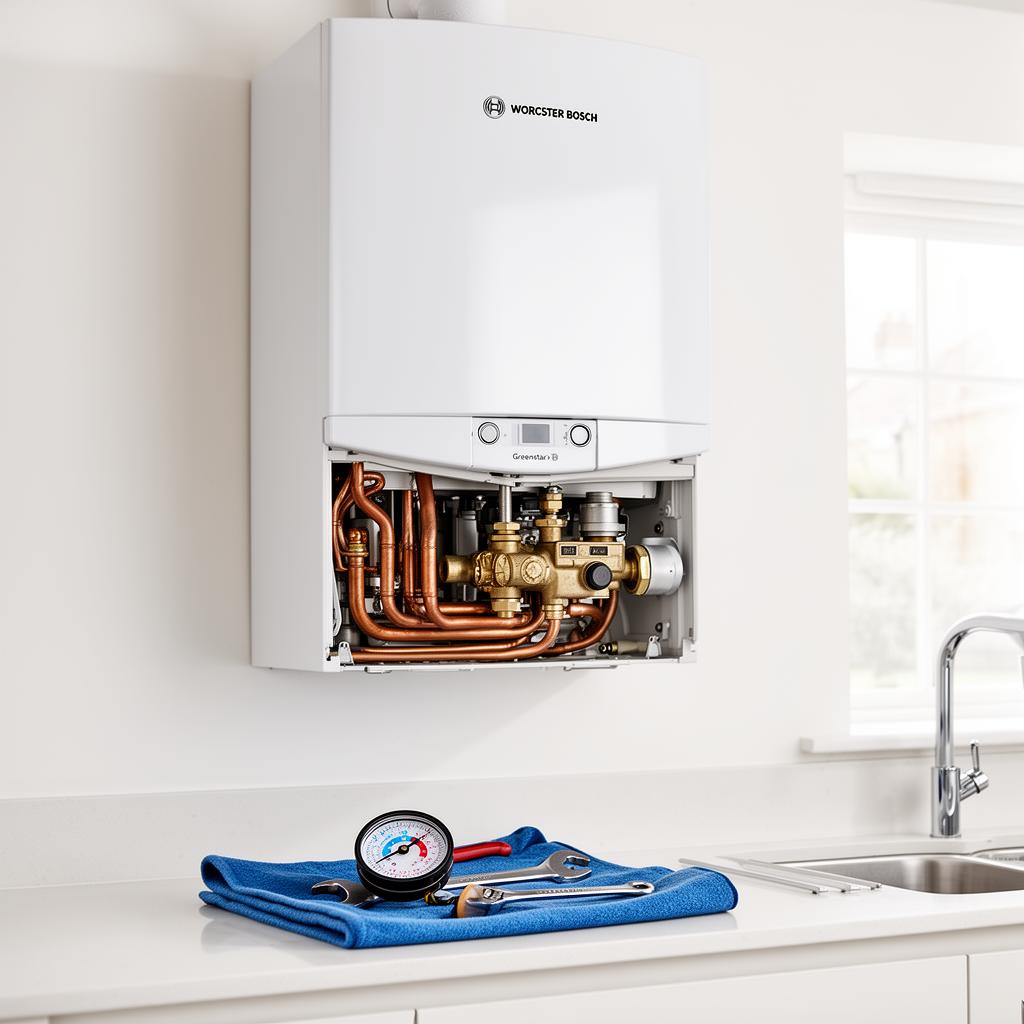
Victorian terraces and villas in this area typically have solid or part-solid walls, original chimney breasts that sometimes still house older flue routes, and pipework that's been extended and altered over more than a century of use. That history means it's worth checking existing pipe runs properly rather than assuming they're sized correctly for a modern boiler. We see enough of this housing stock locally to know where problems commonly hide, from undersized microbore pipework to poorly routed condensate drains. Nearest neighbours on our round are Radstock, Westfield, Paulton. Our van runs the A362 to reach you, 2 miles out from the Radstock workshop. What changes a new boiler price in Midsomer Norton more than the brand is the building itself: victorian terraces and modern estates drive different flue routes, gas-pipe sizing and controls choices. That's why we visit before fixing a price.
Also covering the lanes around Midsomer Norton
We cover Midsomer Norton alongside Radstock (BA3), Westfield (BA3), Paulton (BS39), Chilcompton (BA3) — so spares, follow-ups and annual visits are easy to schedule together.
Why Midsomer Norton work is specified differently
Victorian terraces and villas in this area typically have solid or part-solid walls, original chimney breasts that sometimes still house older flue routes, and pipework that's been extended and altered over more than a century of use. That history means it's worth checking existing pipe runs properly rather than assuming they're sized correctly for a modern boiler. We see enough of this housing stock locally to know where problems commonly hide, from undersized microbore pipework to poorly routed condensate drains. Nearest neighbours on our round are Radstock, Westfield, Paulton. Our van runs the A362 to reach you, 2 miles out from the Radstock workshop. What changes a new boiler price in Midsomer Norton more than the brand is the building itself: victorian terraces and modern estates drive different flue routes, gas-pipe sizing and controls choices. That's why we visit before fixing a price.
Qualifications behind the work
Qualifies your install for the full 10-year manufacturer guarantee* on supported models.
362+ verified reviews from real customers across BA and BS postcodes.
No verbal-only quotes — every figure is in writing with the boiler, controls and warranty spelled out.
Our engineers aren't paid on what you buy — there's no incentive to upsell you to a bigger boiler.
Typical ranges by job — Midsomer Norton
- Like-for-like combi swap: low–mid £k range
- Back-boiler removal & combi conversion: mid–high £k range
- Full system + cylinder upgrade: higher range
- Oil boiler swap (no tank work): mid range
- Oil boiler + tank replacement: higher range
Common queries, answered honestly
- What actually happens on install day?
- The engineer isolates the gas or oil supply and water, removes the old boiler, fits and pressure-tests the new one, connects the flue and condensate, and commissions the system. For a straight swap this is usually one day; a conversion, relocation, or cylinder change can run into a second depending on the pipework involved.
- Is a magnetic filter really necessary, or is it an upsell?
- It's a genuine manufacturer requirement, not an add-on we invent — most boiler warranties are conditional on a system filter being fitted, particularly on hard water. The filter catches magnetite sludge and debris circulating in the system before it reaches the boiler's heat exchanger, which is what actually causes blockages and noise over time.
- What paperwork do I get once the job's finished?
- You'll get a Benchmark commissioning checklist for the boiler, a building notice or Building Control completion certificate for notifiable work, manufacturer warranty registration confirmation, and a Gas Safe (or OFTEC) record of the work. Keep these together — they're what a future buyer's solicitor or a warranty claim will ask for.
- How do we decide between a combi boiler and a boiler-plus-cylinder system?
- It comes down to hot water demand and available space. A combi heats water on demand with no cylinder to fill, which suits smaller households and single-bathroom homes, while a system or regular boiler with a cylinder stores hot water and copes far better where two bathrooms or a bath and shower run at the same time.
- What does "commissioning" a boiler actually involve?
- Commissioning is setting the boiler up correctly for the property rather than just switching it on: checking gas or oil pressure and flow rates, setting flow temperatures, testing safety devices, balancing the system, and completing the manufacturer's Benchmark checklist. Skipping this properly is one of the most common reasons warranty claims get refused later.
- The property has multiple gas appliances across shared rooms — does that complicate the safety check?
- Every gas appliance and flue in the property needs checking as part of the annual CP12, whether that's one boiler and a cooker or several appliances across a shared house. We schedule this as one visit covering the whole property so you get a single certificate rather than piecing several together.
Coverage detail for BA3
- County
- Somerset
- Postcode district
- BA3
- Settlement type
- town
- Nearest classified road
- A362
- Distance from our base
- 2 miles (Radstock, BA3)
- Typical building stock
- Victorian terraces and modern estates
- Water hardness
- very hard limestone water
- Fuel availability
- mains gas across most of the area
- Customer mix
- a mix of owner-occupied and rented homes
- Nearby areas covered
- Radstock, Westfield, Paulton, Chilcompton
Practical considerations across BA3
Why very hard limestone water shortens boiler life around Midsomer Norton
The limestone geology under Somerset gives Midsomer Norton very hard limestone water, which drops calcium carbonate out of solution as soon as it's heated. Inside a combi's plate heat exchanger the gaps between plates are only a millimetre or two wide, so scale narrows the waterways long before it's visible anywhere else in the system. The first symptom is usually a hot tap that runs warm rather than hot, or a boiler that fires more often for the same demand. Left unchecked, scale insulates the exchanger from the burner, forces flue gases hotter, and can crack the exchanger from thermal stress. A scale reducer fitted on the mains feed, sized to the property's flow rate, is cheaper to install once than to replace a heat exchanger twice.
Oil tank de-sludging: why it's not optional
Oil sitting in a tank for years accumulates water from condensation and fine sediment that settles at the bottom, and over time this forms a sludge layer that can be drawn into the fuel line, particularly when the tank is nearly empty and the outlet pulls from lower in the tank than usual. Sludge blocks fine oil filters and burner nozzles, which shows up as burner lockouts or a boiler that won't fire cleanly rather than as an obvious tank problem. De-sludging drains and cleans the tank base without necessarily removing the whole tank, and it's worth doing when a tank is inherited with a property, before switching to a new boiler, or if lockouts recur despite the filter and nozzle being replaced. It's a preventative job that's cheaper done on schedule than after a burner failure it caused.
Heating challenges specific to Victorian terraces
Victorian terraces around Midsomer Norton typically have solid brick external walls with no cavity to insulate, higher ceilings than modern housing, and original suspended timber ground floors that can be draughty if the underfloor void isn't sealed properly — all of which push heat loss calculations higher than floor area alone suggests. Radiators original to these houses, or fitted decades ago to replace them, are frequently undersized for a lower modern flow temperature even if they coped adequately at the older, higher flow temperature the system used to run at. Chimney breasts, where retained, offer a route for a flue or liner as covered elsewhere, but where they've been removed, alternative flue routes need more careful planning on a terrace's narrow rear elevation. We treat Victorian terrace heat loss calculations as their own case rather than applying modern housing assumptions.
Mixed owner-occupied and rented housing in Midsomer Norton
Midsomer Norton's mix of owner-occupied and rented housing means we regularly work to two different sets of expectations on the same street — a landlord wanting the minimum reliable, compliant system at reasonable cost for a tenanted property, and an owner-occupier next door wanting a longer-term investment in efficiency and comfort. Both are legitimate priorities, but they lead to different specifications: a landlord's replacement boiler decision is often driven by the annual gas safety record and reliable compliance, while an owner-occupier's decision more often factors in flow temperature optimisation and controls for their own daily comfort. We ask which category a job falls into early, since it changes the questions worth asking about the property and the recommendation that follows.
What different boiler noises usually mean
A kettling or rumbling sound from a boiler is most often scale or sludge build-up on the heat exchanger causing localised boiling as water is trapped and overheated in restricted channels — the heating equivalent of a kettle furring up. A banging or knocking sound in pipework, sometimes called water hammer, is usually caused by a valve closing too quickly or trapped air rather than the boiler itself. A whining or humming sound tends to point to the circulating pump, either from wear or from air in the system reducing lubrication at the bearing. Diagnosing correctly from the noise alone isn't reliable enough to act on without checking system pressure, inhibitor condition and the pump directly, but the noise itself is a useful first indicator of which of those to check first.
Signs a boiler repair is no longer the right call
A boiler that's failing repeatedly, needing a different part replaced every service, or over roughly ten to fifteen years old is approaching the point where continued repair costs more over time than replacement, particularly once a heat exchanger — the most expensive single part — starts to show signs of failure through leaks or reduced output. Efficiency is the other half of the calculation: an older non-condensing boiler running at 70-80% efficiency against a modern condensing combi at over 90% means a meaningful chunk of every unit of fuel burned in the old boiler is simply lost up the flue. We give a straight answer on repair versus replace based on the fault found and the boiler's age and condition, rather than defaulting to whichever is more profitable to us on the day.
Pumped-oil versus gravity feed: does it matter?
Older oil systems sometimes still rely on gravity feed, where the tank sits higher than the burner and oil flows down to it under its own weight; a pumped system uses the burner's internal pump to draw oil up from a tank at any level, including below the boiler. Gravity feed limits where a tank can be sited and is more prone to airlocks if the line runs dry, while a pumped system is more flexible on tank position but needs the pipe run and lift height kept within the burner pump's rated capacity — usually no more than a few metres of lift and a set maximum run length. When we replace an oil boiler we check which type the existing tank and pipework support before assuming a straight swap, because a tank sited for gravity feed may need repositioning or a different pump to suit a modern burner.
Being minutes away in Midsomer Norton
Midsomer Norton sits close enough to our Radstock base, just 2 miles via the A362, that a diagnostic visit or a return trip for a part doesn't add the delay it would on a job further afield. That's practically useful on jobs where a fault only shows itself once a boiler's been running for a while, or where a part needs collecting after an initial diagnosis rather than being carried on the off-chance. It doesn't change how the job itself is done — the same Gas Safe and OFTEC standards and the same commissioning paperwork apply regardless of distance — but it does mean less waiting between visits on multi-stage jobs like a full system upgrade that needs a survey, a flush, and an installation visit in sequence.
Nozzle replacement and baffle cleaning on oil burners
An oil burner's nozzle atomises fuel into a fine spray for combustion, and it wears from constant fuel flow at pressure, gradually changing the spray pattern away from the burner manufacturer's specification even before it visibly fails. A worn nozzle burns less cleanly, producing more soot that coats the heat exchanger's baffles, and a sooted heat exchanger loses efficiency in the same way scale does on a gas boiler's plates. Standard practice on an annual oil service is to replace the nozzle as a matter of course, rather than wait for a fault, and to remove and clean the baffles so the heat exchanger surfaces are exposed to combustion heat properly again. Skipping nozzle replacement to save a service visit's minor parts cost is a false economy against the fuel wasted by a poorly atomising burner.
How to get this priced
Correct sizing matters more than most people realise for boiler service cost: an undersized system struggles to keep up, and an oversized one costs more to run and buy than it needs to. We size against the property's actual heat loss and hot water demand, not a rule of thumb. Photos of the existing setup speed up pricing for town properties like these. Planning constraints are usually light here, so external work is checked first. Our van runs the A362 to reach you, 2 miles out from the Radstock workshop.
Related help for Midsomer Norton
- New Boiler Cost in Midsomer NortonHonest, area-specific pricing guidance for a new combi, system or oil boiler — with no obligation site visit.
- Emergency Boiler Repair in Midsomer NortonSame-week (often same-day) no-heat and no-hot-water call-outs for gas and oil boilers.
- Landlord Gas Safety Certificate (CP12) in Midsomer NortonAnnual CP12 inspections for landlords and letting agents — digital certificate the same day.
- Boiler Replacement Quote in Midsomer NortonFree, no-obligation site visits and written specifications for old boiler replacements.
- Oil Boiler Service Cost in Midsomer NortonWhat an OFTEC registered oil boiler service costs locally, what is included, and what a tank inspection adds.
- Oil Boiler Repair in Midsomer NortonOil boiler lockouts, sooting and no heat call outs for homes off the mains gas grid, diagnosed before parts are quoted.
- Boiler Installation in Midsomer NortonNew combi, system and regular boiler installations for gas and oil homes — fixed prices, manufacturer warranties.
- Gas Boiler Installation in Midsomer NortonGas Safe registered installations and upgrades for mains gas homes across Bath, Radstock and Wells.
New Worcester boiler with a 10 year guarantee*
Free no-obligation quotes for installation, servicing & repairs across BA & BS postcodes.