
New Boiler Cost, Chewton Mendip New Boiler Prices (BA3)
Older stone-built cottages, Victorian terraces, 1930s semis and newer estate housing all heat differently, and new boiler cost needs to reflect that rather than treating every property the same. Radiator sizing, pipe runs and flue positions change with the building, not the postcode. We're Gas Safe registered, OFTEC registered and a Worcester Bosch Accredited Installer, and we price new boiler cost against what your particular building actually needs. homes alongside small commercial and agricultural premises make up most enquiries from this postcode. Our van runs the A39 to reach you, 5 miles out from the Radstock workshop. In Chewton Mendip itself (BA3, Somerset) that usually means stone village homes, roughly 5 miles from the workshop.
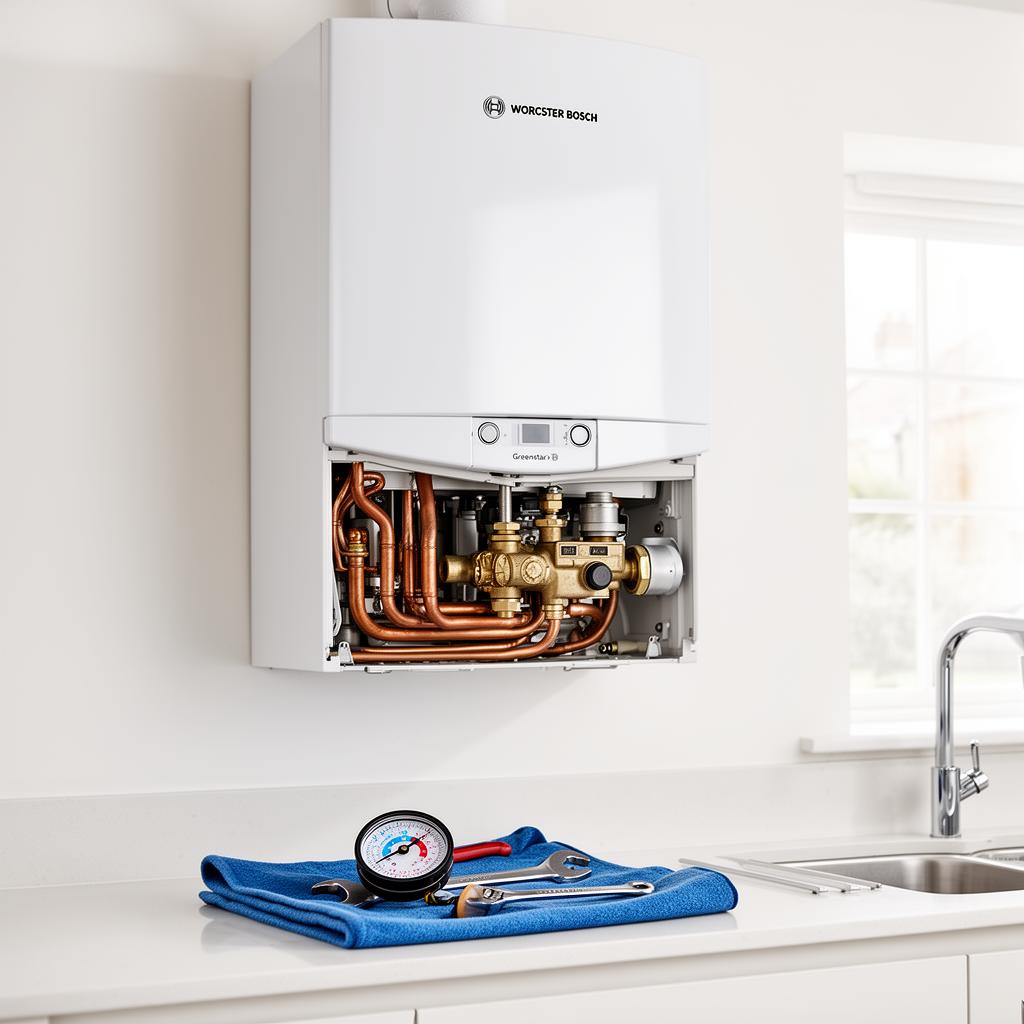
Being within or close to the Mendip or Chew Valley area of natural beauty doesn't generally add restrictions to internal heating work, but it does often coincide with rural, off-grid or agricultural properties where oil storage, tank siting and access are the more relevant practical considerations. We treat those two things — the planning designation and the practical rural setting — as separate issues, and deal with whichever actually applies to your property rather than assuming both automatically apply. Terrain is valley floor, which matters for condensate runs and tank siting. Access is lane access, so parking, spoil removal and delivery timing get planned in advance. What changes a new boiler price in Chewton Mendip more than the brand is the building itself: stone village homes drive different flue routes, gas-pipe sizing and controls choices. That's why we visit before fixing a price.
Why Chewton Mendip households use us
Qualifies your install for the full 10-year manufacturer guarantee* on supported models.
No verbal-only quotes — every figure is in writing with the boiler, controls and warranty spelled out.
362+ verified reviews from real customers across BA and BS postcodes.
Our engineers aren't paid on what you buy — there's no incentive to upsell you to a bigger boiler.
Local conditions we plan around in BA3
Being within or close to the Mendip or Chew Valley area of natural beauty doesn't generally add restrictions to internal heating work, but it does often coincide with rural, off-grid or agricultural properties where oil storage, tank siting and access are the more relevant practical considerations. We treat those two things — the planning designation and the practical rural setting — as separate issues, and deal with whichever actually applies to your property rather than assuming both automatically apply. Terrain is valley floor, which matters for condensate runs and tank siting. Access is lane access, so parking, spoil removal and delivery timing get planned in advance. What changes a new boiler price in Chewton Mendip more than the brand is the building itself: stone village homes drive different flue routes, gas-pipe sizing and controls choices. That's why we visit before fixing a price.
Where else we work near Chewton Mendip
We cover Chewton Mendip alongside Litton (BA3), Priddy (BA5), Gurney Slade (BA3), Binegar (BA3) — so spares, follow-ups and annual visits are easy to schedule together.
What changes the price — Chewton Mendip
- Boiler type (combi vs system vs regular)
- Flue route and length
- Gas / oil supply pipe sizing
- Controls (basic, smart, weather-comp)
- Power-flush vs chemical clean
- Condensate routing and any external works
Questions before you book
- What's a CP12 and do I need one as a landlord?
- A CP12 (Landlord Gas Safety Record) confirms every gas appliance in a rented property has passed an annual safety check by a Gas Safe registered engineer. It's a legal requirement before letting and at each renewal, a copy has to go to tenants, and it needs to be renewed every 12 months without a gap.
- What paperwork do I get once the job's finished?
- You'll get a Benchmark commissioning checklist for the boiler, a building notice or Building Control completion certificate for notifiable work, manufacturer warranty registration confirmation, and a Gas Safe (or OFTEC) record of the work. Keep these together — they're what a future buyer's solicitor or a warranty claim will ask for.
- What if a part for my existing boiler isn't available anymore?
- Manufacturers stop stocking parts for discontinued models after a number of years, and once that happens a repair simply isn't possible even if the fault itself is minor. We'll confirm parts availability with the manufacturer before quoting a repair, and if it's a dead end we'll explain your replacement options honestly.
- What's the difference between a power flush and a chemical flush?
- A chemical flush circulates a cleaning agent through the existing system to loosen light debris, while a power flush uses a pump to force water at higher velocity and reversed direction through radiators and pipework to shift heavier sludge. We usually recommend the more thorough power flush before connecting a new boiler to an older system.
- Who actually carries out the work?
- A Gas Safe and, where relevant, OFTEC registered engineer from our own small team carries out the job — we don't sub the install out to a third party after quoting. You deal with the same people from survey through to commissioning and any aftercare calls.
- What is condensate and why does its routing matter?
- Condensate is the mildly acidic water produced by a modern condensing boiler as it extracts extra heat from the flue gases, and it needs a route to an internal drain or, less ideally, an external soakaway. In colder or more exposed locations an external condensate pipe can freeze and shut the boiler down, so internal routing is worth prioritising where the layout allows it.
Area data we work from
- County
- Somerset
- Postcode district
- BA3
- Settlement type
- village
- Nearest classified road
- A39
- Distance from our base
- 5 miles (Radstock, BA3)
- Typical building stock
- stone village homes
- Water hardness
- very hard limestone water
- Fuel availability
- mains gas with off-grid pockets
- Customer mix
- homes alongside small commercial and agricultural premises
- Nearby areas covered
- Litton, Priddy, Gurney Slade, Binegar
Things we check around Chewton Mendip
Radiator sizing after lowering the flow temperature
Running a boiler at a lower flow temperature — typically 55°C or below rather than the old default of 70-80°C — improves condensing efficiency measurably, but it also reduces the heat output of every radiator in the house, because a radiator's output falls roughly with the square of the temperature difference to the room. Radiators sized correctly for a 75°C flow can end up unable to heat the room properly at 55°C unless they're upsized or supplemented. We check each radiator against the lower design flow temperature before recommending it, and where a room falls short we look at whether a larger single panel, a double panel, or an additional radiator on that circuit closes the gap, rather than pushing the flow temperature back up and giving away the efficiency gain.
Condensate soakaways where there's no convenient drain
Properties without a nearby internal waste connection or external gully for the boiler's condensate — common on rural plots around Chewton Mendip where the nearest drain run is a long way from the boiler's location — sometimes need a dedicated condensate soakaway instead. This is a small pit filled with granular material that the condensate, which is mildly acidic, can disperse into gradually rather than running to a drain at all. Sizing and siting it correctly matters: it needs to be far enough from foundations and sited where the local ground can actually absorb the modest but steady volume a boiler produces, particularly over a long heating season. Where ground conditions make a soakaway unreliable, running a longer insulated pipe to a proper drainage connection is usually the safer long-term choice even though it's more work to install.
Chasing pipework into lime plaster and stone walls
Solid stone or cob walls finished in lime plaster, common in the older parts of Chewton Mendip, behave very differently to modern plasterboard when a pipe run needs chasing in. Lime plaster is softer and more porous than gypsum, so cutting a neat, consistent chase without blowing the surface needs a slower hand and finer disc than a stud-wall job, and any repair has to be made good in a lime-based skim rather than modern filler, which can trap moisture behind it and cause the patch to fail. On solid stone we sometimes surface-mount pipework in painted conduit instead of chasing, particularly where the wall is a significant structural thickness and chasing would weaken it. Knowing which approach a wall needs before starting avoids expensive plaster damage.
Signs a boiler repair is no longer the right call
A boiler that's failing repeatedly, needing a different part replaced every service, or over roughly ten to fifteen years old is approaching the point where continued repair costs more over time than replacement, particularly once a heat exchanger — the most expensive single part — starts to show signs of failure through leaks or reduced output. Efficiency is the other half of the calculation: an older non-condensing boiler running at 70-80% efficiency against a modern condensing combi at over 90% means a meaningful chunk of every unit of fuel burned in the old boiler is simply lost up the flue. We give a straight answer on repair versus replace based on the fault found and the boiler's age and condition, rather than defaulting to whichever is more profitable to us on the day.
Why very hard limestone water shortens boiler life around Chewton Mendip
The limestone geology under Somerset gives Chewton Mendip very hard limestone water, which drops calcium carbonate out of solution as soon as it's heated. Inside a combi's plate heat exchanger the gaps between plates are only a millimetre or two wide, so scale narrows the waterways long before it's visible anywhere else in the system. The first symptom is usually a hot tap that runs warm rather than hot, or a boiler that fires more often for the same demand. Left unchecked, scale insulates the exchanger from the burner, forces flue gases hotter, and can crack the exchanger from thermal stress. A scale reducer fitted on the mains feed, sized to the property's flow rate, is cheaper to install once than to replace a heat exchanger twice.
What voids or protects a Worcester Bosch extended guarantee
Worcester Bosch's longer guarantee periods on qualifying installations are conditional on the boiler being installed and commissioned by an Accredited Installer, on an annual service being carried out (by any Gas Safe registered engineer, not necessarily the original installer) within the required window each year, and on system water quality being maintained to the standard set out in their published guidance — meaning a system flush at installation, correct inhibitor dosing, and in hard water areas a scale reducer or filter as specified. Missing a single annual service, or installing without the required water treatment, can reduce cover back to the manufacturer's standard guarantee period even if the boiler itself has had no faults. Keeping the Benchmark record and service history together is what lets a claim be assessed quickly if it's ever needed.
Single-pipe circuits in older stone cottages
A lot of the stone cottages and farmhouses around Chewton Mendip were plumbed decades ago on a single-pipe gravity circuit, where each radiator draws from and returns to the same loop rather than having its own flow and return. It works, but radiators furthest from the boiler receive water that's already cooled after giving up heat to the ones before it, so the far end of the house is always the coldest. Converting to a two-pipe layout means new pipe runs, which in a stone cottage often means chasing lime plaster or lifting flagstones — not a trivial job. Where a full rewire of the pipework isn't wanted, we sometimes improve balance instead by oversizing the radiators nearest the end of the run and fitting TRVs to hold back the ones nearest the boiler.
Your next move in BA3
The next step for new boiler cost is a site visit, not a phone-only estimate. Seeing the property, the current system and the access lets us give you a figure that holds up once the work starts, rather than one that changes on the day. Call 07516 118198, Monday to Friday, 8:30am to 5pm, and we'll arrange a time that suits. We can usually pair the visit with other work in Litton to keep the trip efficient. Typical era of build is mixed-cottage, which affects existing pipework and system cleanliness. homes alongside small commercial and agricultural premises make up most enquiries from this postcode.
Related help for Chewton Mendip
- Emergency Boiler Repair in Chewton MendipSame-week (often same-day) no-heat and no-hot-water call-outs for gas and oil boilers.
- Landlord Gas Safety Certificate (CP12) in Chewton MendipAnnual CP12 inspections for landlords and letting agents — digital certificate the same day.
- Boiler Replacement Quote in Chewton MendipFree, no-obligation site visits and written specifications for old boiler replacements.
- Oil Boiler Service Cost in Chewton MendipWhat an OFTEC registered oil boiler service costs locally, what is included, and what a tank inspection adds.
- Oil Boiler Repair in Chewton MendipOil boiler lockouts, sooting and no heat call outs for homes off the mains gas grid, diagnosed before parts are quoted.
- Boiler Service Cost in Chewton MendipAnnual gas boiler service pricing, what the check covers, and how a landlord certificate can be combined in one visit.
- Boiler Installation in Chewton MendipNew combi, system and regular boiler installations for gas and oil homes — fixed prices, manufacturer warranties.
- Gas Boiler Installation in Chewton MendipGas Safe registered installations and upgrades for mains gas homes across Bath, Radstock and Wells.
New Worcester boiler with a 10 year guarantee*
Free no-obligation quotes for installation, servicing & repairs across BA & BS postcodes.