
Oil Boiler Repairs in Peasedown St John
Getting quotes for oil boiler repairs can feel like a gamble when you don't know the trade. You want someone who turns up when they say they will, explains what they're doing, and leaves you with a system you understand. That's the standard we work to from 24 Bristol Road, Radstock BA3 3EE. We're Gas Safe registered, OFTEC registered and a Worcester Bosch Accredited Installer, so the paperwork and the workmanship both hold up to scrutiny. Access is open suburban, so parking, spoil removal and delivery timing get planned in advance. Typical era of build is postwar, which affects existing pipework and system cleanliness. In Peasedown St John itself (BA2, Somerset) that usually means 1960s–2000s estates and bungalows, roughly 3 miles from the workshop.
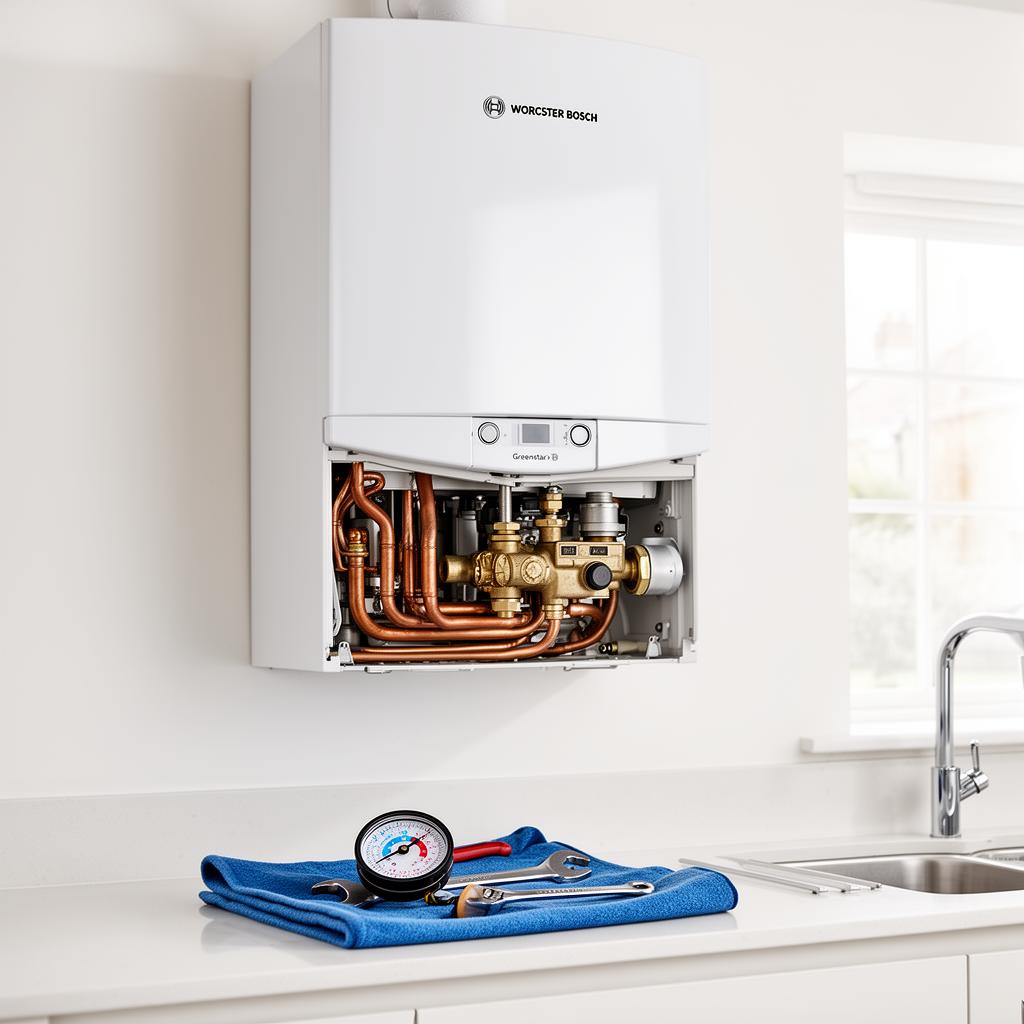
What you get, start to finish
- Boiler will not fire or keeps locking out
- Sooting, puffing and smoky flue faults
- Pump, photocell and control diagnostics
- Sludge and water in tank dealt with properly
- Free written quote, no obligation
- Local aftercare from a 3-mile base
Registrations and how work is signed off
Reg. 549918 — every gas job notified to Building Control and a CP12 issued where required.
No verbal-only quotes. You'll get the boiler model, controls and warranty in writing before we book.
362+ verified reviews from real customers across BA and BS postcodes.
Qualifies your install for the full 10-year manufacturer guarantee* on supported models.
Nearby villages and neighbourhoods
Beyond Peasedown St John we're frequently on jobs in Wellow (BA2), Radstock (BA3), Bath (BA1) and Clandown (BA3) — so spares, follow-ups and annual services are straightforward.
Local conditions we plan around in BA2
Water here runs off carboniferous limestone and Jurassic oolite, which makes it very hard by national standards. Hard water accelerates scale build-up inside heat exchangers, cylinders and pipework, which shortens the working life of components that aren't protected against it. On jobs in this area we factor scale protection into the specification rather than treating it as an optional extra, because the difference between a protected and unprotected system shows up within a few years, not decades. It's a genuine local variable, not generic sales advice, and it applies whether the property is on mains gas or oil. Terrain is level, which matters for condensate runs and tank siting. Water here is very hard limestone water, so scale protection is specified accordingly. Peasedown St John is roughly 3 miles from our Radstock base via the A367. Typical property stock here: 1960s–2000s estates and bungalows. Mains gas covers most of Peasedown St John, so the usual choice is between a modern combi or a system boiler with a cylinder — we'll size it correctly for the home, not just swap like-for-like. Repair calls in Peasedown St John usually get a same-week visit, with most common faults fixed on the first attempt.
Peasedown St John questions we get asked
- We've still got an old back boiler behind the fireplace — what's involved in removing it?
- Removing a back boiler means capping off the gas and water connections behind the fireplace, making good the opening or fitting a new fire/surround if you're keeping one, and rerouting pipework to the new combi or system boiler's position. It's more work than a like-for-like swap but a common upgrade on the older housing stock in this area.
- Where can a new boiler actually be sited in the property?
- A combi is usually fitted in a kitchen cupboard, utility room, loft, or garage as long as flue clearances to windows, doors, and boundaries are met. A system or regular boiler with a cylinder needs a bit more room and usually stays close to its current position unless you're relocating the whole system, which is a bigger job.
- Our house is a 1950s/60s ex-council property — is there anything specific to watch for?
- These properties often still have original solid-fuel-era chimneys or older cylinder cupboards that limit boiler positioning, and some have had piecemeal heating upgrades over the decades that leave odd pipe sizing. We check the existing pipework diameter and radiator balance during survey, since it affects whether a straightforward combi swap will actually heat the whole house evenly.
- Is a magnetic filter really necessary, or is it an upsell?
- It's a genuine manufacturer requirement, not an add-on we invent — most boiler warranties are conditional on a system filter being fitted, particularly on hard water. The filter catches magnetite sludge and debris circulating in the system before it reaches the boiler's heat exchanger, which is what actually causes blockages and noise over time.
- What are your opening hours, and can you help out of hours?
- Our published hours are Monday to Friday, 8:30am to 5pm, and that's when the phones are answered and jobs are booked. We're honest that we don't run a round-the-clock emergency line, so if you're planning ahead, call during those hours on 07516 118198 and we'll get you booked in.
- Since Peasedown St John is so close to your base, can you offer more flexible slot timing?
- Being close by does help us fit shorter jobs — like a service or a minor repair — into gaps between other bookings more easily than a longer round trip would allow. For a full installation the timescale is the same either way, since the work itself takes the same amount of time regardless of the drive.
Next step for Peasedown St John
Getting more than one quote for oil boiler repairs is sensible, and we're happy to be one of them. Ask each tradesperson the same questions about what's included, what's excluded, and what registration they hold, so you're comparing genuinely equivalent quotes rather than a headline figure with hidden gaps. Send the appliance make, model and any fault code and you get a straight answer, not a sales script. Our van runs the A367 to reach you, 3 miles out from the Radstock workshop. a mix of owner-occupied and rented homes make up most enquiries from this postcode.
Peasedown St John at a glance
- County
- Somerset
- Postcode district
- BA2
- Settlement type
- town
- Nearest classified road
- A367
- Distance from our base
- 3 miles (Radstock, BA3)
- Typical building stock
- 1960s–2000s estates and bungalows
- Water hardness
- very hard limestone water
- Fuel availability
- mains gas across most of the area
- Customer mix
- a mix of owner-occupied and rented homes
- Nearby areas covered
- Wellow, Radstock, Bath, Clandown
Things we check around Peasedown St John
Mixed owner-occupied and rented housing in Peasedown St John
Peasedown St John's mix of owner-occupied and rented housing means we regularly work to two different sets of expectations on the same street — a landlord wanting the minimum reliable, compliant system at reasonable cost for a tenanted property, and an owner-occupier next door wanting a longer-term investment in efficiency and comfort. Both are legitimate priorities, but they lead to different specifications: a landlord's replacement boiler decision is often driven by the annual gas safety record and reliable compliance, while an owner-occupier's decision more often factors in flow temperature optimisation and controls for their own daily comfort. We ask which category a job falls into early, since it changes the questions worth asking about the property and the recommendation that follows.
Oil tank de-sludging: why it's not optional
Oil sitting in a tank for years accumulates water from condensation and fine sediment that settles at the bottom, and over time this forms a sludge layer that can be drawn into the fuel line, particularly when the tank is nearly empty and the outlet pulls from lower in the tank than usual. Sludge blocks fine oil filters and burner nozzles, which shows up as burner lockouts or a boiler that won't fire cleanly rather than as an obvious tank problem. De-sludging drains and cleans the tank base without necessarily removing the whole tank, and it's worth doing when a tank is inherited with a property, before switching to a new boiler, or if lockouts recur despite the filter and nozzle being replaced. It's a preventative job that's cheaper done on schedule than after a burner failure it caused.
Dealing with microbore pipework
Housing from the 1930s to 1960s around Peasedown St John was sometimes retrofitted with 8mm or 10mm microbore pipe run in bundles from a manifold, which was cheap and quick to install at the time but restricts flow badly compared with modern 15mm or 22mm pipe. Microbore is prone to sludge blockage because its narrow bore has no capacity to carry debris in suspension — it settles instead. A radiator on a microbore tail that's cold at the bottom is very often a blocked tail rather than a boiler fault. Replacing microbore with standard-bore pipe usually needs some floor lifting, but on a heating upgrade it removes a recurring source of cold radiators rather than papering over it with another flush.
Electronic and physical scale reducers compared
In very hard limestone water areas like Peasedown St John, a scale reducer fitted on the boiler's cold feed protects the heat exchanger without the ongoing salt and drainage requirements of a full water softener. Physical scale reducers use a polyphosphate or template-assisted crystallisation cartridge that alters how calcium carbonate crystallises so it's less likely to adhere to hot surfaces; electronic and electromagnetic devices claim a similar effect without a cartridge to replace, though the evidence base for electronic types is weaker and more inconsistent than for physical media. Manufacturers including Worcester Bosch now specify a scale reducer or softener as a condition of extended guarantees in hard water areas, so the choice affects warranty validity as well as long-term performance, not just descale frequency.
Nozzle replacement and baffle cleaning on oil burners
An oil burner's nozzle atomises fuel into a fine spray for combustion, and it wears from constant fuel flow at pressure, gradually changing the spray pattern away from the burner manufacturer's specification even before it visibly fails. A worn nozzle burns less cleanly, producing more soot that coats the heat exchanger's baffles, and a sooted heat exchanger loses efficiency in the same way scale does on a gas boiler's plates. Standard practice on an annual oil service is to replace the nozzle as a matter of course, rather than wait for a fault, and to remove and clean the baffles so the heat exchanger surfaces are exposed to combustion heat properly again. Skipping nozzle replacement to save a service visit's minor parts cost is a false economy against the fuel wasted by a poorly atomising burner.
What different boiler noises usually mean
A kettling or rumbling sound from a boiler is most often scale or sludge build-up on the heat exchanger causing localised boiling as water is trapped and overheated in restricted channels — the heating equivalent of a kettle furring up. A banging or knocking sound in pipework, sometimes called water hammer, is usually caused by a valve closing too quickly or trapped air rather than the boiler itself. A whining or humming sound tends to point to the circulating pump, either from wear or from air in the system reducing lubrication at the bearing. Diagnosing correctly from the noise alone isn't reliable enough to act on without checking system pressure, inhibitor condition and the pump directly, but the noise itself is a useful first indicator of which of those to check first.
Peasedown St John's place within the wider Somerset area we cover
Peasedown St John is one of several neighbourhoods we work in around the wider area, and while the postcode district and general water hardness and building stock trends are shared with the surrounding district, the specific street-level access, parking and property type still varies enough locally that we treat each visit on its own facts rather than applying a generic area answer. Nearby areas we also cover include Wellow, Radstock and Bath, which is relevant mainly where a customer wants comparable jobs referenced or where a single visit can sensibly cover more than one nearby property in the same trip. The underlying trade standards — Gas Safe, OFTEC, correct commissioning — don't vary by neighbourhood, only the practical details of the job do.
Other boiler services in Peasedown St John
- Boiler Installation in Peasedown St JohnNew combi, system and regular boiler installations for gas and oil homes — fixed prices, manufacturer warranties.
- Gas Boiler Installation in Peasedown St JohnGas Safe registered installations and upgrades for mains gas homes across Bath, Radstock and Wells.
- Oil Boiler Installation in Peasedown St JohnOFTEC-trained oil boiler specialist for rural homes off the gas grid — tank and boiler replacements.
- Boiler Servicing in Peasedown St JohnAnnual boiler services to keep your warranty valid and your home safe, efficient and warm.
- Maintenance & Repair in Peasedown St JohnDiagnostics, repairs and breakdown call-outs for gas and oil boilers across BA and BS postcodes.
- Landlord Gas Safety Certificates in Peasedown St JohnAnnual CP12 landlord gas safety records issued on the day, for single lets, HMOs, holiday lets and whole portfolios.
- Oil Boiler Servicing in Peasedown St JohnOFTEC registered annual servicing for oil boilers, including nozzle, electrode, filter and smoke test work on off grid homes.
- Oil Tank Replacement in Peasedown St JohnBunded oil tank replacement and relocation with base preparation, new supply line and OFTEC paperwork on completion.
New Worcester boiler with a 10 year guarantee*
Free no-obligation quotes for installation, servicing & repairs across BA & BS postcodes.