
Oil Boiler Servicing — Burnett (BS31)
Getting quotes for oil boiler servicing can feel like a gamble when you don't know the trade. You want someone who turns up when they say they will, explains what they're doing, and leaves you with a system you understand. That's the standard we work to from 24 Bristol Road, Radstock BA3 3EE. We're Gas Safe registered, OFTEC registered and a Worcester Bosch Accredited Installer, so the paperwork and the workmanship both hold up to scrutiny. Off-grid oil and LPG are common on these lanes, which changes the appliance shortlist.
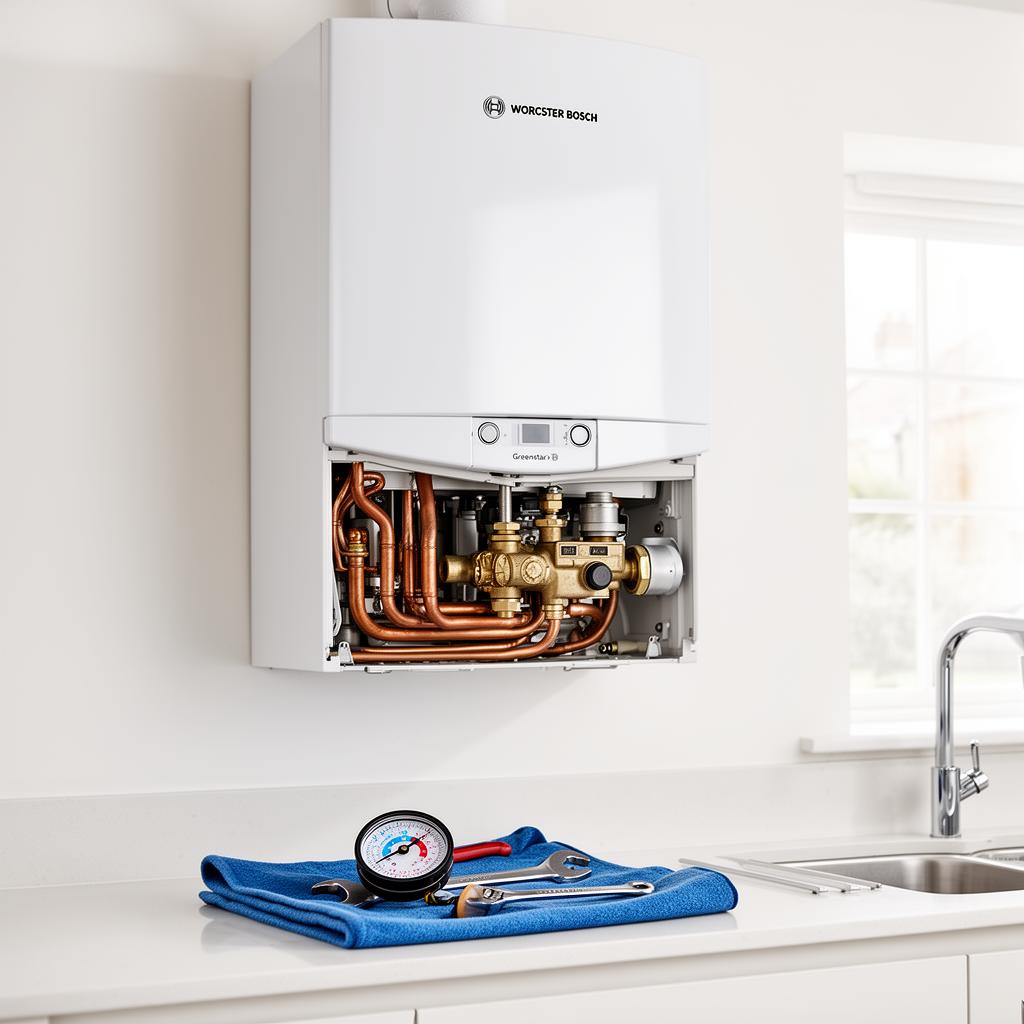
Scope of work, itemised
- OFTEC registered oil specialist
- Nozzle, electrode and fuel filter renewed
- Smoke test and pump pressure set correctly
- Oil tank and supply line inspected
- Free written quote, no obligation
- Local aftercare from a 9-mile base
How Somerset building stock shapes the spec
Rural owner-occupiers and smallholders in this area often have specific priorities: reliable heating for a property that may be some distance from immediate help if something fails, sensible running costs on an off-grid fuel, and a system that copes with an older, harder-to-insulate building. We hear these priorities often enough locally to factor them into how we survey and specify rural properties, rather than applying a standard suburban approach. Our van runs the unclassified to reach you, 9 miles out from the Radstock workshop. Burnett is roughly 9 miles from our Radstock base via the unclassified. Typical property stock here: farmhouses and cottages. Burnett sits in the Somerset BS31 postcode and is part of our weekly run, so local response is quick. Repair calls in Burnett usually get a same-week visit, with most common faults fixed on the first attempt.
What backs up a Burnett quote
362+ verified reviews from real customers across BA and BS postcodes.
Qualifies your install for the full 10-year manufacturer guarantee* on supported models.
Reg. 549918 — every gas job notified to Building Control and a CP12 issued where required.
No verbal-only quotes. You'll get the boiler model, controls and warranty in writing before we book.
Within reach of the unclassified
Beyond Burnett we're frequently on jobs in Keynsham (BS31), Saltford (BS31), Compton Dando (BS39) and Chew Magna (BS40) — so spares, follow-ups and annual services are straightforward.
Straight answers for Burnett homeowners
- What are your opening hours, and can you help out of hours?
- Our published hours are Monday to Friday, 8:30am to 5pm, and that's when the phones are answered and jobs are booked. We're honest that we don't run a round-the-clock emergency line, so if you're planning ahead, call during those hours on 07516 118198 and we'll get you booked in.
- We're off the gas grid around Burnett — what are our heating options?
- Properties around Burnett are often off the mains gas network, so the practical choices are oil or LPG. Oil suits homes with room for a tank and reasonable delivery access; LPG is worth considering where space is tighter. We're OFTEC registered for oil work and Gas Safe registered for LPG appliances, so we can talk through both fairly.
- How do we decide between a combi boiler and a boiler-plus-cylinder system?
- It comes down to hot water demand and available space. A combi heats water on demand with no cylinder to fill, which suits smaller households and single-bathroom homes, while a system or regular boiler with a cylinder stores hot water and copes far better where two bathrooms or a bath and shower run at the same time.
- What paperwork do I get once the job's finished?
- You'll get a Benchmark commissioning checklist for the boiler, a building notice or Building Control completion certificate for notifiable work, manufacturer warranty registration confirmation, and a Gas Safe (or OFTEC) record of the work. Keep these together — they're what a future buyer's solicitor or a warranty claim will ask for.
- Our access is a long farm track — does that limit what you can do?
- It doesn't stop the job, but it does affect timing and delivery, particularly for oil tank work or a new cylinder that needs a specific access point. Tell us about gates, track surface, or turning space when you book, and for oil deliveries afterwards it's worth checking the same access suits your fuel supplier.
- What does "commissioning" a boiler actually involve?
- Commissioning is setting the boiler up correctly for the property rather than just switching it on: checking gas or oil pressure and flow rates, setting flow temperatures, testing safety devices, balancing the system, and completing the manufacturer's Benchmark checklist. Skipping this properly is one of the most common reasons warranty claims get refused later.
Next step for Burnett
If oil boiler servicing is something you're looking into, the simplest next step is a call on 07516 118198 during our normal hours, Monday to Friday, 8:30am to 5pm. Tell us a bit about the property and what's prompted the enquiry, and we'll take it from there. We can usually pair the visit with other work in Keynsham to keep the trip efficient. Terrain is level, which matters for condensate runs and tank siting.
Local reference data
- County
- Somerset
- Postcode district
- BS31
- Settlement type
- hamlet
- Nearest classified road
- unclassified
- Distance from our base
- 9 miles (Radstock, BA3)
- Typical building stock
- farmhouses and cottages
- Water hardness
- hard water
- Fuel availability
- off-grid oil and LPG common
- Customer mix
- rural owner-occupiers and smallholdings
- Nearby areas covered
- Keynsham, Saltford, Compton Dando, Chew Magna
Detail that matters in Burnett
Oil tank bunding and fire valve rules
Off-grid properties around Burnett rely on oil, and OFTEC's technical standards (OFS T100) set out when a tank needs a bund — a sealed secondary container holding at least 110% of the tank's capacity — based on how close it sits to a watercourse, drain, or boundary, and whether it's within a certain distance of a building. A fire valve fitted at the tank outlet, with its sensor mounted above the boiler's burner, will shut off oil flow automatically if a fire starts, and it's now expected on virtually every new or replaced installation. We check both bunding and fire-valve provision on every oil quote, because retrofitting a bund after a tank is delivered and sited is a second job, not a five-minute add-on.
- Bund holds 110% of tank capacity minimum
- Fire valve sensor mounted directly above the burner
- Distances to boundaries and drains checked against OFS T100
- Applies to replacement tanks, not just new installs
Chasing pipework into lime plaster and stone walls
Solid stone or cob walls finished in lime plaster, common in the older parts of Burnett, behave very differently to modern plasterboard when a pipe run needs chasing in. Lime plaster is softer and more porous than gypsum, so cutting a neat, consistent chase without blowing the surface needs a slower hand and finer disc than a stud-wall job, and any repair has to be made good in a lime-based skim rather than modern filler, which can trap moisture behind it and cause the patch to fail. On solid stone we sometimes surface-mount pipework in painted conduit instead of chasing, particularly where the wall is a significant structural thickness and chasing would weaken it. Knowing which approach a wall needs before starting avoids expensive plaster damage.
Common boiler fault codes and what usually causes them
Most modern boilers display a fault code on the control panel when they lock out, and while the exact code differs between manufacturers, the underlying causes cluster into a small number of categories: low system pressure (often from a small leak or after bleeding radiators), ignition failure (a worn electrode, gas supply issue, or blocked condensate causing a safety shutdown), or a failed sensor reporting an implausible temperature reading. A condensate blockage or freeze specifically tends to show a distinct code from a genuine ignition fault, which is why checking the external condensate pipe for ice before calling out an engineer in a cold snap can sometimes resolve the issue without a visit at all. We ask for the exact fault code and any recent history — a bled radiator, a cold snap, a recent service — before attending, since it often narrows down the likely cause before we arrive.
What different boiler noises usually mean
A kettling or rumbling sound from a boiler is most often scale or sludge build-up on the heat exchanger causing localised boiling as water is trapped and overheated in restricted channels — the heating equivalent of a kettle furring up. A banging or knocking sound in pipework, sometimes called water hammer, is usually caused by a valve closing too quickly or trapped air rather than the boiler itself. A whining or humming sound tends to point to the circulating pump, either from wear or from air in the system reducing lubrication at the bearing. Diagnosing correctly from the noise alone isn't reliable enough to act on without checking system pressure, inhibitor condition and the pump directly, but the noise itself is a useful first indicator of which of those to check first.
Electronic and physical scale reducers compared
In hard water areas like Burnett, a scale reducer fitted on the boiler's cold feed protects the heat exchanger without the ongoing salt and drainage requirements of a full water softener. Physical scale reducers use a polyphosphate or template-assisted crystallisation cartridge that alters how calcium carbonate crystallises so it's less likely to adhere to hot surfaces; electronic and electromagnetic devices claim a similar effect without a cartridge to replace, though the evidence base for electronic types is weaker and more inconsistent than for physical media. Manufacturers including Worcester Bosch now specify a scale reducer or softener as a condition of extended guarantees in hard water areas, so the choice affects warranty validity as well as long-term performance, not just descale frequency.
What a proper heating quote should include
A quote worth relying on states the specific boiler or equipment model, the labour and materials it covers, whether a system flush and magnetic filter are included, what happens to old equipment removal and disposal, and what's excluded — an unexpected gas pipe upsizing or asbestos-containing material discovered during removal, for example, which can't always be known before work starts. It should also state who's completing the Gas Safe or OFTEC notification and Benchmark commissioning record, since that's the paperwork that protects both the manufacturer's guarantee and the property's compliance history when it's sold. A vague one-line quote makes comparing genuinely different offers difficult, because two prices that look similar can cover very different scopes of actual work.
- Specific make and model, not just "combi boiler"
- Flush and magnetic filter stated as included or excluded
- Old equipment removal and disposal covered
- Notification and Benchmark record responsibility stated
Choosing between oil, LPG and electric off the gas grid
Properties around Burnett without a mains gas connection have a genuine choice between oil, bulk LPG and direct electric heating (or a heat pump), and the right answer depends on more than fuel price alone. Oil needs tank space, safe access for tanker delivery and the bunding/fire-valve provisions covered elsewhere, but gives strong, controllable heat output well suited to older, harder-to-heat stone properties. LPG suits households wanting gas-style controllability without oil's storage and burner maintenance, at a generally higher unit cost. A heat pump works best paired with good insulation and lower flow temperature emitters, and suits a property being upgraded rather than one where radiators and insulation are staying as they are. We look at the specific building's insulation, radiator sizing and available space before recommending a fuel switch rather than assuming one option suits every off-grid property.
Access and parking constraints before we start work
Burnett's unmade tracks and gated fields affect how a job is planned before any pipework is touched. A boiler, cylinder or radiators have to be carried in, and on some streets that means checking parking permit zones or loading restrictions in advance rather than on the day; on farm tracks it means confirming a van can actually reach the building in wet weather, since a track that's fine in summer can be impassable after heavy rain. Old equipment being removed — an oil tank, an old cylinder, a cast iron boiler — needs the same access route in reverse, and weight matters as much as width. We ask about access and parking at the quoting stage specifically so it doesn't become a delay on the installation day.
Nozzle replacement and baffle cleaning on oil burners
An oil burner's nozzle atomises fuel into a fine spray for combustion, and it wears from constant fuel flow at pressure, gradually changing the spray pattern away from the burner manufacturer's specification even before it visibly fails. A worn nozzle burns less cleanly, producing more soot that coats the heat exchanger's baffles, and a sooted heat exchanger loses efficiency in the same way scale does on a gas boiler's plates. Standard practice on an annual oil service is to replace the nozzle as a matter of course, rather than wait for a fault, and to remove and clean the baffles so the heat exchanger surfaces are exposed to combustion heat properly again. Skipping nozzle replacement to save a service visit's minor parts cost is a false economy against the fuel wasted by a poorly atomising burner.
Other boiler services in Burnett
- Boiler Installation in BurnettNew combi, system and regular boiler installations for gas and oil homes — fixed prices, manufacturer warranties.
- Gas Boiler Installation in BurnettGas Safe registered installations and upgrades for mains gas homes across Bath, Radstock and Wells.
- Oil Boiler Installation in BurnettOFTEC-trained oil boiler specialist for rural homes off the gas grid — tank and boiler replacements.
- Boiler Servicing in BurnettAnnual boiler services to keep your warranty valid and your home safe, efficient and warm.
- Maintenance & Repair in BurnettDiagnostics, repairs and breakdown call-outs for gas and oil boilers across BA and BS postcodes.
- Landlord Gas Safety Certificates in BurnettAnnual CP12 landlord gas safety records issued on the day, for single lets, HMOs, holiday lets and whole portfolios.
- Oil Boiler Repairs in BurnettOil boiler breakdown repairs across rural Somerset, from lockouts and sooting to pump, photocell and control faults.
- Oil Tank Replacement in BurnettBunded oil tank replacement and relocation with base preparation, new supply line and OFTEC paperwork on completion.
New Worcester boiler with a 10 year guarantee*
Free no-obligation quotes for installation, servicing & repairs across BA & BS postcodes.