
Local Oil Boiler Installation for Trudoxhill
Working across Radstock, Bath and the surrounding Mendip villages day to day means we see plenty of variation in how oil boiler installation needs to be approached — different building ages, different water supplies, different access. That local experience feeds into how we survey and quote, rather than working from a single generic template. Gas Safe registered, OFTEC registered, 24 Bristol Road, Radstock BA3 3EE. Terrain is level, which matters for condensate runs and tank siting. homes alongside small commercial and agricultural premises make up most enquiries from this postcode. In Trudoxhill itself (BA11, Somerset) that usually means stone cottages, roughly 8 miles from the workshop.
Why Trudoxhill work is specified differently
Village lanes around here are sometimes narrow enough that arranging a specific arrival time matters more than it would on a wider suburban road, particularly if a new boiler, cylinder or radiators need to be carried some distance from where a van can park. We ask about this when scheduling the survey so the job itself isn't held up by something that could have been sorted in advance. Typical era of build is mixed-cottage, which affects existing pipework and system cleanliness. Access is lane access, so parking, spoil removal and delivery timing get planned in advance. Trudoxhill is roughly 8 miles from our Radstock base via the unclassified. Typical property stock here: stone cottages. A meaningful share of properties around Trudoxhill are off the gas grid, so oil boiler installs and tank swaps make up a fair part of what we do locally. For oil work we look at the tank's age, bund condition, fire valve and fuel-line route as part of the survey — not as an afterthought.
Where else we work near Trudoxhill
Beyond Trudoxhill we're frequently on jobs in Nunney (BA11), Wanstrow (BA4), Frome (BA11) and Leigh upon Mendip (BA3) — so spares, follow-ups and annual services are straightforward.
Scope of work, itemised
- OFTEC trained & registered
- Internal & external oil boilers
- Oil tank replacements
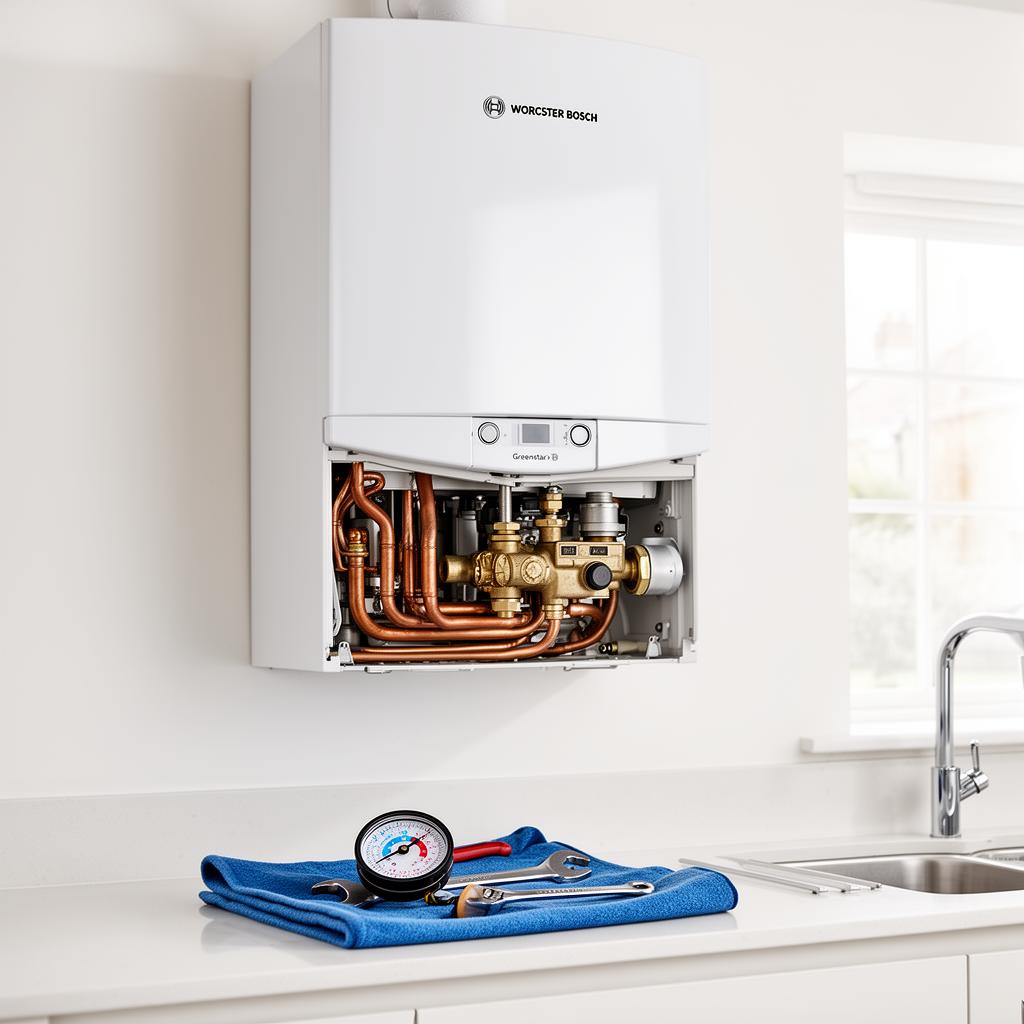
- Worcester Greenstar & Grant Vortex
- Free written quote, no obligation
- Local aftercare from a 8-mile base
Proof, paperwork and accountability
Qualifies your install for the full 10-year manufacturer guarantee* on supported models.
Reg. 549918 — every gas job notified to Building Control and a CP12 issued where required.
Based at 24 Bristol Rd, Radstock — every job is run by the team that quoted it.
No verbal-only quotes. You'll get the boiler model, controls and warranty in writing before we book.
Trudoxhill questions we get asked
- What if a part for my existing boiler isn't available anymore?
- Manufacturers stop stocking parts for discontinued models after a number of years, and once that happens a repair simply isn't possible even if the fault itself is minor. We'll confirm parts availability with the manufacturer before quoting a repair, and if it's a dead end we'll explain your replacement options honestly.
- Our water's not as hard here — do we still need a power flush?
- Water hardness affects scale, but sludge from years of corrosion and old radiators builds up regardless of hardness. If your system's been running a long time or you've had cold spots on radiators, a power flush before fitting a new boiler protects it just as much here as anywhere with harder water.
- What is condensate and why does its routing matter?
- Condensate is the mildly acidic water produced by a modern condensing boiler as it extracts extra heat from the flue gases, and it needs a route to an internal drain or, less ideally, an external soakaway. In colder or more exposed locations an external condensate pipe can freeze and shut the boiler down, so internal routing is worth prioritising where the layout allows it.
- How much longer does a full conversion take compared to a straight boiler swap?
- A straight like-for-like swap in the same location is typically a single working day. Converting boiler type (for example back boiler to combi, or oil to LPG), relocating the boiler, or adding a new cylinder usually needs one to two extra days for additional pipework, flue routing, and electrical work, which we'll scope out at survey.
- What actually happens on install day?
- The engineer isolates the gas or oil supply and water, removes the old boiler, fits and pressure-tests the new one, connects the flue and condensate, and commissions the system. For a straight swap this is usually one day; a conversion, relocation, or cylinder change can run into a second depending on the pipework involved.
- What's the warranty on a new boiler installed in Trudoxhill?
- Up to 10 years on qualifying Worcester Bosch installs registered through us as Accredited Installers. Other manufacturers typically offer 5–7 years.
How to get this priced
On qualifying Worcester Bosch installs carried out as an Accredited Installer, oil boiler installation can come with up to a 10 year guarantee* — the exact terms depend on the specific boiler and installation, and we'll confirm what applies to your property once we've surveyed it. We can usually pair the visit with other work in Nunney to keep the trip efficient. Most of what we open up here is stone cottages, which dictates flue routes and pipe sizing. Mains gas covers much of the area, with off-grid pockets, which changes the appliance shortlist.
Trudoxhill coverage and distances
- County
- Somerset
- Postcode district
- BA11
- Settlement type
- village
- Nearest classified road
- unclassified
- Distance from our base
- 8 miles (Radstock, BA3)
- Typical building stock
- stone cottages
- Water hardness
- moderately hard water
- Fuel availability
- mains gas with off-grid pockets
- Customer mix
- homes alongside small commercial and agricultural premises
- Nearby areas covered
- Nunney, Wanstrow, Frome, Leigh upon Mendip
Detail that matters in Trudoxhill
Single-pipe circuits in older stone cottages
A lot of the stone cottages and farmhouses around Trudoxhill were plumbed decades ago on a single-pipe gravity circuit, where each radiator draws from and returns to the same loop rather than having its own flow and return. It works, but radiators furthest from the boiler receive water that's already cooled after giving up heat to the ones before it, so the far end of the house is always the coldest. Converting to a two-pipe layout means new pipe runs, which in a stone cottage often means chasing lime plaster or lifting flagstones — not a trivial job. Where a full rewire of the pipework isn't wanted, we sometimes improve balance instead by oversizing the radiators nearest the end of the run and fitting TRVs to hold back the ones nearest the boiler.
LPG as an alternative to oil off the gas grid
Properties around Trudoxhill that sit off the mains gas network aren't limited to oil — bulk LPG, stored in an above-ground tank on a concrete base with the same OFTEC-style clearance and access rules as oil, runs standard gas-rated boilers with only a change of injector and pressure setting rather than a different boiler entirely. It suits households that want a gas hob and gas-style modulation rather than an oil burner's on/off firing pattern. The tank still needs delivery access for a tanker, which on some rural driveways is the deciding factor over oil. We check the access route for the largest realistic delivery vehicle before recommending LPG over oil, because a tank that can't be filled easily causes more disruption than the fuel choice was meant to solve.
Radiator sizing after lowering the flow temperature
Running a boiler at a lower flow temperature — typically 55°C or below rather than the old default of 70-80°C — improves condensing efficiency measurably, but it also reduces the heat output of every radiator in the house, because a radiator's output falls roughly with the square of the temperature difference to the room. Radiators sized correctly for a 75°C flow can end up unable to heat the room properly at 55°C unless they're upsized or supplemented. We check each radiator against the lower design flow temperature before recommending it, and where a room falls short we look at whether a larger single panel, a double panel, or an additional radiator on that circuit closes the gap, rather than pushing the flow temperature back up and giving away the efficiency gain.
Common boiler fault codes and what usually causes them
Most modern boilers display a fault code on the control panel when they lock out, and while the exact code differs between manufacturers, the underlying causes cluster into a small number of categories: low system pressure (often from a small leak or after bleeding radiators), ignition failure (a worn electrode, gas supply issue, or blocked condensate causing a safety shutdown), or a failed sensor reporting an implausible temperature reading. A condensate blockage or freeze specifically tends to show a distinct code from a genuine ignition fault, which is why checking the external condensate pipe for ice before calling out an engineer in a cold snap can sometimes resolve the issue without a visit at all. We ask for the exact fault code and any recent history — a bled radiator, a cold snap, a recent service — before attending, since it often narrows down the likely cause before we arrive.
What different boiler noises usually mean
A kettling or rumbling sound from a boiler is most often scale or sludge build-up on the heat exchanger causing localised boiling as water is trapped and overheated in restricted channels — the heating equivalent of a kettle furring up. A banging or knocking sound in pipework, sometimes called water hammer, is usually caused by a valve closing too quickly or trapped air rather than the boiler itself. A whining or humming sound tends to point to the circulating pump, either from wear or from air in the system reducing lubrication at the bearing. Diagnosing correctly from the noise alone isn't reliable enough to act on without checking system pressure, inhibitor condition and the pump directly, but the noise itself is a useful first indicator of which of those to check first.
Plume management kits for restricted flue positions
Where the ideal, shortest flue route would discharge too close to a boundary, a window, or onto a neighbouring property — a common constraint on tight plots in Trudoxhill — a plume management kit extends the flue's discharge point away from the boiler's own wall penetration, directing the visible water vapour plume and flue gases to a compliant location instead. It adds ductwork and sometimes a small additional fan to overcome the extra resistance, and it has to be specified against the specific boiler's approved kit range rather than improvised, since flue certification only covers tested combinations. It's a legitimate way to fit a boiler on a plot where the compliant flue route and the sensible boiler location aren't the same wall, without compromising on clearances to solve it.
Condensate soakaways where there's no convenient drain
Properties without a nearby internal waste connection or external gully for the boiler's condensate — common on rural plots around Trudoxhill where the nearest drain run is a long way from the boiler's location — sometimes need a dedicated condensate soakaway instead. This is a small pit filled with granular material that the condensate, which is mildly acidic, can disperse into gradually rather than running to a drain at all. Sizing and siting it correctly matters: it needs to be far enough from foundations and sited where the local ground can actually absorb the modest but steady volume a boiler produces, particularly over a long heating season. Where ground conditions make a soakaway unreliable, running a longer insulated pipe to a proper drainage connection is usually the safer long-term choice even though it's more work to install.
What voids or protects a Worcester Bosch extended guarantee
Worcester Bosch's longer guarantee periods on qualifying installations are conditional on the boiler being installed and commissioned by an Accredited Installer, on an annual service being carried out (by any Gas Safe registered engineer, not necessarily the original installer) within the required window each year, and on system water quality being maintained to the standard set out in their published guidance — meaning a system flush at installation, correct inhibitor dosing, and in hard water areas a scale reducer or filter as specified. Missing a single annual service, or installing without the required water treatment, can reduce cover back to the manufacturer's standard guarantee period even if the boiler itself has had no faults. Keeping the Benchmark record and service history together is what lets a claim be assessed quickly if it's ever needed.
Other boiler services in Trudoxhill
- Boiler Installation in TrudoxhillNew combi, system and regular boiler installations for gas and oil homes — fixed prices, manufacturer warranties.
- Gas Boiler Installation in TrudoxhillGas Safe registered installations and upgrades for mains gas homes across Bath, Radstock and Wells.
- Boiler Servicing in TrudoxhillAnnual boiler services to keep your warranty valid and your home safe, efficient and warm.
- Maintenance & Repair in TrudoxhillDiagnostics, repairs and breakdown call-outs for gas and oil boilers across BA and BS postcodes.
- Landlord Gas Safety Certificates in TrudoxhillAnnual CP12 landlord gas safety records issued on the day, for single lets, HMOs, holiday lets and whole portfolios.
- Oil Boiler Servicing in TrudoxhillOFTEC registered annual servicing for oil boilers, including nozzle, electrode, filter and smoke test work on off grid homes.
- Oil Boiler Repairs in TrudoxhillOil boiler breakdown repairs across rural Somerset, from lockouts and sooting to pump, photocell and control faults.
- Oil Tank Replacement in TrudoxhillBunded oil tank replacement and relocation with base preparation, new supply line and OFTEC paperwork on completion.
New Worcester boiler with a 10 year guarantee*
Free no-obligation quotes for installation, servicing & repairs across BA & BS postcodes.