
Local Boiler Installation for Bathampton
Boiler Installation covers a range of jobs, from straightforward like-for-like swaps to full system redesigns with new pipework, controls and hot water storage. The right approach depends on boiler location, flue length, pump speed, radiator sizing and how the property loses heat. As a Gas Safe and OFTEC registered firm and a Worcester Bosch Accredited Installer working out of Radstock, we specify each install against the building rather than fitting a standard package regardless of fit. Terrain is level, which matters for condensate runs and tank siting. Typical era of build is mixed-cottage, which affects existing pipework and system cleanliness. In Bathampton itself (BA2, Somerset) that usually means stone cottages and waterside properties, roughly 9 miles from the workshop.
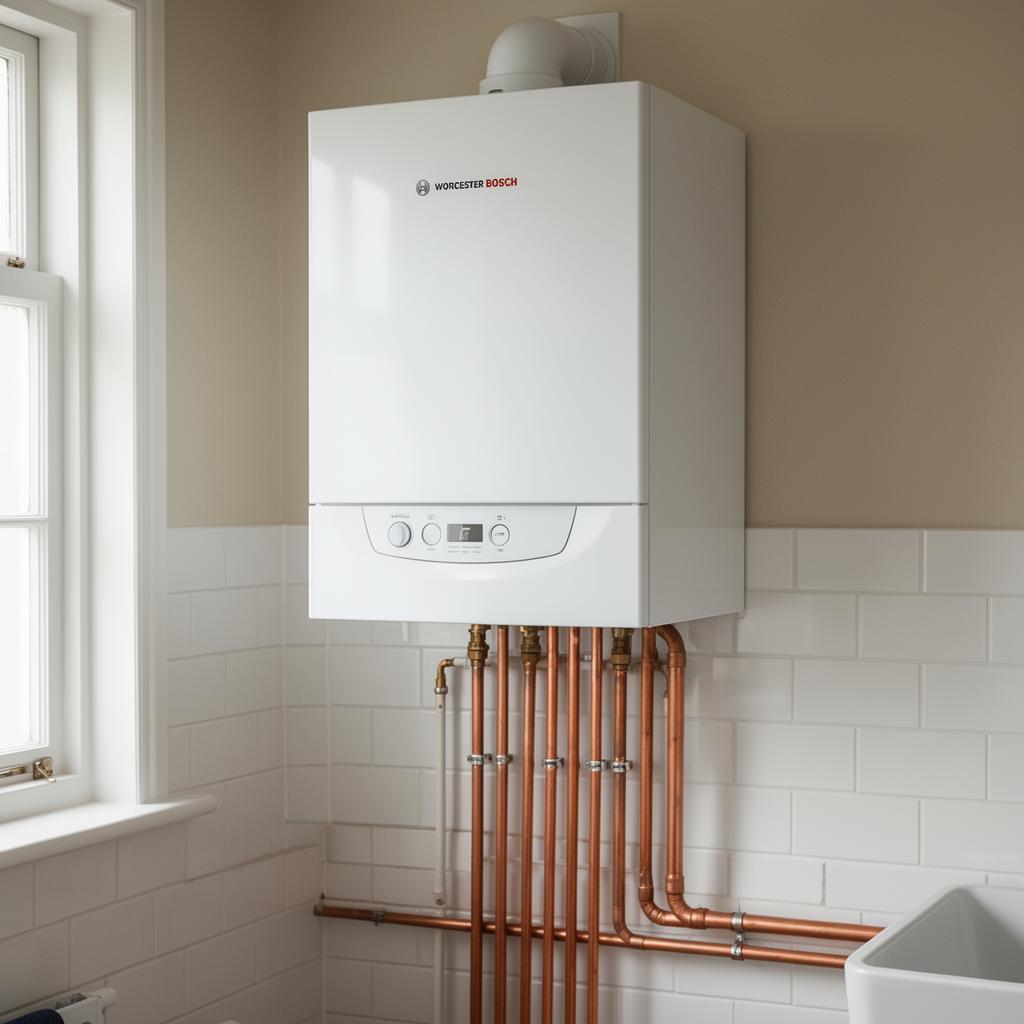
How Somerset building stock shapes the spec
Water here runs off carboniferous limestone and Jurassic oolite, which makes it very hard by national standards. Hard water accelerates scale build-up inside heat exchangers, cylinders and pipework, which shortens the working life of components that aren't protected against it. On jobs in this area we factor scale protection into the specification rather than treating it as an optional extra, because the difference between a protected and unprotected system shows up within a few years, not decades. It's a genuine local variable, not generic sales advice, and it applies whether the property is on mains gas or oil. Access is lane access, so parking, spoil removal and delivery timing get planned in advance. Water here is very hard limestone water, so scale protection is specified accordingly. Bathampton is roughly 9 miles from our Radstock base via the A36. Typical property stock here: stone cottages and waterside properties. Bathampton sits in the Somerset BA2 postcode and is part of our weekly run, so local response is quick. When we quote boiler installation here we factor in flue routing, condensate fall and gas-supply pipe sizing before the price is fixed.
Scope of work, itemised
- Combi, system & regular boilers
- Like-for-like swaps in a single day
- Worcester, Vaillant, Ideal, Grant & more
- Up to 10-year manufacturer warranties
- Free written quote, no obligation
- Local aftercare from a 9-mile base
Nearby villages and neighbourhoods
Beyond Bathampton we're frequently on jobs in Bath (BA1), Bathford (BA1), Batheaston (BA1) and Monkton Combe (BA2) — so spares, follow-ups and annual services are straightforward.
Registrations and how work is signed off
Qualifies your install for the full 10-year manufacturer guarantee* on supported models.
No verbal-only quotes. You'll get the boiler model, controls and warranty in writing before we book.
Oil boilers, oil tanks and pipework — fully certified for off-grid installs and replacements.
Based at 24 Bristol Rd, Radstock — every job is run by the team that quoted it.
Boiler Installation FAQs for BA2
- Do you cover Bathampton?
- Yes. Bathampton is 9 miles from our workshop at 24 Bristol Road, Radstock BA3 3EE, reached via the A36, and it's a regular part of our working area. We're Gas Safe and OFTEC registered, so we cover both mains gas and oil work out here without treating it as a special trip.
- What's the difference between a power flush and a chemical flush?
- A chemical flush circulates a cleaning agent through the existing system to loosen light debris, while a power flush uses a pump to force water at higher velocity and reversed direction through radiators and pipework to shift heavier sludge. We usually recommend the more thorough power flush before connecting a new boiler to an older system.
- What paperwork do I get once the job's finished?
- You'll get a Benchmark commissioning checklist for the boiler, a building notice or Building Control completion certificate for notifiable work, manufacturer warranty registration confirmation, and a Gas Safe (or OFTEC) record of the work. Keep these together — they're what a future buyer's solicitor or a warranty claim will ask for.
- Is oil more expensive to run than mains gas?
- Oil and gas prices both move with the wholesale market and neither is fixed, so a blanket answer isn't honest. What we can say is that a modern condensing oil boiler, correctly sized and commissioned, will run considerably more efficiently than an old non-condensing model — that efficiency gap usually matters more than the fuel choice itself.
- How does LPG heating differ from mains gas day to day?
- An LPG boiler works the same way as a mains gas one day to day, but the gas is stored in a tank or cylinders on site and topped up by a supplier rather than piped in continuously. That means keeping an eye on tank levels and arranging deliveries, but appliance choice, controls, and servicing requirements are otherwise very similar.
- Do you cover all of Bathampton?
- Yes — every street in BA2 that falls under Bathampton, plus the lanes towards Bath and Bathford. We're 9 miles away in Radstock, so most jobs are reached in well under half an hour.
Booking work in Bathampton
For landlords, boiler installation usually needs to fit around a tenancy, so let us know at the outset if the property is occupied and what access arrangements work for the tenant. We'll build that into the quote and the schedule rather than assuming an empty property. Call 07516 118198 and we will confirm a visit slot for BA2. Water here is very hard limestone water, so scale protection is specified accordingly. Access is lane access, so parking, spoil removal and delivery timing get planned in advance.
Bathampton coverage and distances
- County
- Somerset
- Postcode district
- BA2
- Settlement type
- village
- Nearest classified road
- A36
- Distance from our base
- 9 miles (Radstock, BA3)
- Typical building stock
- stone cottages and waterside properties
- Water hardness
- very hard limestone water
- Fuel availability
- mains gas with off-grid pockets
- Customer mix
- homes alongside small commercial and agricultural premises
- Nearby areas covered
- Bath, Bathford, Batheaston, Monkton Combe
Practical considerations across BA2
Building Control notification for boiler work
Installing or replacing a boiler is notifiable work under Building Regulations, and a Gas Safe or OFTEC registered installer working within their scheme's competent-person arrangements notifies the local authority electronically on completion, which avoids the homeowner having to apply for Building Regulations approval separately and pay a council fee for it. This generates a compliance certificate that matters at the point of selling the property — conveyancing solicitors routinely ask for it, and its absence can hold up a sale. Work carried out by someone outside a competent-person scheme has to be notified to Building Control directly and inspected, which is slower and often more expensive. We notify every applicable installation as standard and the certificate follows automatically.
Radiator sizing after lowering the flow temperature
Running a boiler at a lower flow temperature — typically 55°C or below rather than the old default of 70-80°C — improves condensing efficiency measurably, but it also reduces the heat output of every radiator in the house, because a radiator's output falls roughly with the square of the temperature difference to the room. Radiators sized correctly for a 75°C flow can end up unable to heat the room properly at 55°C unless they're upsized or supplemented. We check each radiator against the lower design flow temperature before recommending it, and where a room falls short we look at whether a larger single panel, a double panel, or an additional radiator on that circuit closes the gap, rather than pushing the flow temperature back up and giving away the efficiency gain.
Chasing pipework into lime plaster and stone walls
Solid stone or cob walls finished in lime plaster, common in the older parts of Bathampton, behave very differently to modern plasterboard when a pipe run needs chasing in. Lime plaster is softer and more porous than gypsum, so cutting a neat, consistent chase without blowing the surface needs a slower hand and finer disc than a stud-wall job, and any repair has to be made good in a lime-based skim rather than modern filler, which can trap moisture behind it and cause the patch to fail. On solid stone we sometimes surface-mount pipework in painted conduit instead of chasing, particularly where the wall is a significant structural thickness and chasing would weaken it. Knowing which approach a wall needs before starting avoids expensive plaster damage.
Weather compensation: matching flow temperature to outdoor conditions
Weather compensation uses an external sensor to adjust the boiler's flow temperature automatically as outdoor temperature changes, running a lower flow temperature on a mild day and a higher one on a cold one, rather than the fixed flow temperature most boilers are left on permanently. Because condensing boiler efficiency is highest at lower flow and return temperatures, weather compensation keeps the system closer to peak efficiency across the heating season instead of only on the coldest days it was set up for. It needs a compensation curve set to suit the specific building's heat loss characteristics — the same curve on a well-insulated modern semi and a solid-wall Victorian terrace won't give the same comfort result. We set the curve empirically over the first heating season rather than leaving factory defaults in place.
Oil tank de-sludging: why it's not optional
Oil sitting in a tank for years accumulates water from condensation and fine sediment that settles at the bottom, and over time this forms a sludge layer that can be drawn into the fuel line, particularly when the tank is nearly empty and the outlet pulls from lower in the tank than usual. Sludge blocks fine oil filters and burner nozzles, which shows up as burner lockouts or a boiler that won't fire cleanly rather than as an obvious tank problem. De-sludging drains and cleans the tank base without necessarily removing the whole tank, and it's worth doing when a tank is inherited with a property, before switching to a new boiler, or if lockouts recur despite the filter and nozzle being replaced. It's a preventative job that's cheaper done on schedule than after a burner failure it caused.
Bathampton's place within the wider Somerset area we cover
Bathampton is one of several neighbourhoods we work in around the wider area, and while the postcode district and general water hardness and building stock trends are shared with the surrounding district, the specific street-level access, parking and property type still varies enough locally that we treat each visit on its own facts rather than applying a generic area answer. Nearby areas we also cover include Bath, Bathford and Batheaston, which is relevant mainly where a customer wants comparable jobs referenced or where a single visit can sensibly cover more than one nearby property in the same trip. The underlying trade standards — Gas Safe, OFTEC, correct commissioning — don't vary by neighbourhood, only the practical details of the job do.
Signs a boiler repair is no longer the right call
A boiler that's failing repeatedly, needing a different part replaced every service, or over roughly ten to fifteen years old is approaching the point where continued repair costs more over time than replacement, particularly once a heat exchanger — the most expensive single part — starts to show signs of failure through leaks or reduced output. Efficiency is the other half of the calculation: an older non-condensing boiler running at 70-80% efficiency against a modern condensing combi at over 90% means a meaningful chunk of every unit of fuel burned in the old boiler is simply lost up the flue. We give a straight answer on repair versus replace based on the fault found and the boiler's age and condition, rather than defaulting to whichever is more profitable to us on the day.
Electronic and physical scale reducers compared
In very hard limestone water areas like Bathampton, a scale reducer fitted on the boiler's cold feed protects the heat exchanger without the ongoing salt and drainage requirements of a full water softener. Physical scale reducers use a polyphosphate or template-assisted crystallisation cartridge that alters how calcium carbonate crystallises so it's less likely to adhere to hot surfaces; electronic and electromagnetic devices claim a similar effect without a cartridge to replace, though the evidence base for electronic types is weaker and more inconsistent than for physical media. Manufacturers including Worcester Bosch now specify a scale reducer or softener as a condition of extended guarantees in hard water areas, so the choice affects warranty validity as well as long-term performance, not just descale frequency.
Other boiler services in Bathampton
- Gas Boiler Installation in BathamptonGas Safe registered installations and upgrades for mains gas homes across Bath, Radstock and Wells.
- Oil Boiler Installation in BathamptonOFTEC-trained oil boiler specialist for rural homes off the gas grid — tank and boiler replacements.
- Boiler Servicing in BathamptonAnnual boiler services to keep your warranty valid and your home safe, efficient and warm.
- Maintenance & Repair in BathamptonDiagnostics, repairs and breakdown call-outs for gas and oil boilers across BA and BS postcodes.
- Landlord Gas Safety Certificates in BathamptonAnnual CP12 landlord gas safety records issued on the day, for single lets, HMOs, holiday lets and whole portfolios.
- Oil Boiler Servicing in BathamptonOFTEC registered annual servicing for oil boilers, including nozzle, electrode, filter and smoke test work on off grid homes.
- Oil Boiler Repairs in BathamptonOil boiler breakdown repairs across rural Somerset, from lockouts and sooting to pump, photocell and control faults.
- Oil Tank Replacement in BathamptonBunded oil tank replacement and relocation with base preparation, new supply line and OFTEC paperwork on completion.
New Worcester boiler with a 10 year guarantee*
Free no-obligation quotes for installation, servicing & repairs across BA & BS postcodes.