
Compton Martin Boiler Installation
We treat boiler installation as work that has to meet the same standard whether it's a small job or a full system replacement: correct registration, proper commissioning, and documentation you can keep. Gas Safe registered, OFTEC registered and a Worcester Bosch Accredited Installer, based at 24 Bristol Road, Radstock BA3 3EE, that's the baseline we work to on every job, not an upsell. Typical era of build is mixed-cottage, which affects existing pipework and system cleanliness. homes alongside small commercial and agricultural premises make up most enquiries from this postcode. In Compton Martin itself (BS40, North Somerset) that usually means stone village homes, roughly 8 miles from the workshop.
Why Compton Martin work is specified differently
The water supply in this part of the Chew Valley and surrounding area is hard, sitting between the very hard limestone water closer to Bath and the moderately hard supply further out. It's still enough to affect scale build-up over time, particularly in hot water cylinders and combi heat exchangers. We take that into account when specifying protection for a new system rather than assuming the same setup that works on a soft-water supply elsewhere in the country will perform the same way here. Access is lane access, so parking, spoil removal and delivery timing get planned in advance. Mains gas covers much of the area, with off-grid pockets, which changes the appliance shortlist. Compton Martin is roughly 8 miles from our Radstock base via the A368. Typical property stock here: stone village homes. A meaningful share of properties around Compton Martin are off the gas grid, so oil boiler installs and tank swaps make up a fair part of what we do locally. When we quote boiler installation here we factor in flue routing, condensate fall and gas-supply pipe sizing before the price is fixed.
Within reach of the A368
Beyond Compton Martin we're frequently on jobs in Ubley (BS40), West Harptree (BS40), East Harptree (BS40) and Bishop Sutton (BS39) — so spares, follow-ups and annual services are straightforward.
Proof, paperwork and accountability
Based at 24 Bristol Rd, Radstock — every job is run by the team that quoted it.
No verbal-only quotes. You'll get the boiler model, controls and warranty in writing before we book.
Qualifies your install for the full 10-year manufacturer guarantee* on supported models.
Reg. 549918 — every gas job notified to Building Control and a CP12 issued where required.
Scope of work, itemised
- Combi, system & regular boilers
- Like-for-like swaps in a single day
- Worcester, Vaillant, Ideal, Grant & more
- Up to 10-year manufacturer warranties
- Free written quote, no obligation
- Local aftercare from a 8-mile base
Common queries, answered honestly
- What's an unvented cylinder and does it need special installation rules?
- An unvented cylinder stores mains-pressure hot water without a cold water tank in the loft, giving strong pressure at every outlet. Building Regulations require it to be fitted and commissioned by someone holding a specific unvented cylinder qualification (which we hold), including fitting the correct safety valves, because an incorrectly installed unvented cylinder is a pressure vessel hazard.
- What is condensate and why does its routing matter?
- Condensate is the mildly acidic water produced by a modern condensing boiler as it extracts extra heat from the flue gases, and it needs a route to an internal drain or, less ideally, an external soakaway. In colder or more exposed locations an external condensate pipe can freeze and shut the boiler down, so internal routing is worth prioritising where the layout allows it.
- What does "commissioning" a boiler actually involve?
- Commissioning is setting the boiler up correctly for the property rather than just switching it on: checking gas or oil pressure and flow rates, setting flow temperatures, testing safety devices, balancing the system, and completing the manufacturer's Benchmark checklist. Skipping this properly is one of the most common reasons warranty claims get refused later.
- What's actually checked during an annual boiler service?
- A service includes a visual and functional check of the boiler's casing and controls, flue gas analysis to confirm safe and efficient combustion, checking the flame picture and pressure, inspecting seals and condensate, and testing safety devices. It's a safety check as much as a performance one, and it's what keeps most manufacturer warranties valid.
- What are your opening hours, and can you help out of hours?
- Our published hours are Monday to Friday, 8:30am to 5pm, and that's when the phones are answered and jobs are booked. We're honest that we don't run a round-the-clock emergency line, so if you're planning ahead, call during those hours on 07516 118198 and we'll get you booked in.
- Can you do oil boiler work in Compton Martin?
- Yes — we're OFTEC registered. Compton Martin has plenty of off-grid properties, so Worcester Heatslave and Grant Vortex installs (with tank swaps where needed) are routine for us.
How to get this priced
Getting in touch about boiler installation is straightforward: call 07516 118198 within our normal working hours, Monday to Friday, 8:30am to 5pm, describe the property and what you need, and we'll talk through whether a survey makes sense as the next step. Call 07516 118198 and we will confirm a visit slot for BS40. Nearest neighbours on our round are Ubley, West Harptree, East Harptree. homes alongside small commercial and agricultural premises make up most enquiries from this postcode.
Local reference data
- County
- North Somerset
- Postcode district
- BS40
- Settlement type
- village
- Nearest classified road
- A368
- Distance from our base
- 8 miles (Radstock, BA3)
- Typical building stock
- stone village homes
- Water hardness
- hard water
- Fuel availability
- mains gas with off-grid pockets
- Customer mix
- homes alongside small commercial and agricultural premises
- Nearby areas covered
- Ubley, West Harptree, East Harptree, Bishop Sutton
Practical considerations across BS40
Compton Martin's place within the wider North Somerset area we cover
Compton Martin is one of several neighbourhoods we work in around the wider area, and while the postcode district and general water hardness and building stock trends are shared with the surrounding district, the specific street-level access, parking and property type still varies enough locally that we treat each visit on its own facts rather than applying a generic area answer. Nearby areas we also cover include Ubley, West Harptree and East Harptree, which is relevant mainly where a customer wants comparable jobs referenced or where a single visit can sensibly cover more than one nearby property in the same trip. The underlying trade standards — Gas Safe, OFTEC, correct commissioning — don't vary by neighbourhood, only the practical details of the job do.
Wood-burning stoves with a back boiler alongside a main boiler
Some older rural properties around Compton Martin run a wood-burning stove with a back boiler feeding heat into the same central heating circuit as an oil or gas boiler, usually through a thermal store or a cylinder with two coils. Getting this combination to work safely means the stove's back boiler circuit has its own means of dissipating heat if the pump fails or a valve closes while the stove is still burning — a stove can't simply be switched off the way a boiler can if its heat has nowhere to go, so a gravity-fed safety circuit or heat leak radiator is normally required. It's a more involved design than a single-boiler system and needs planning at the point either appliance is replaced, not treated as an afterthought once the new boiler is already fitted.
Radiator sizing after lowering the flow temperature
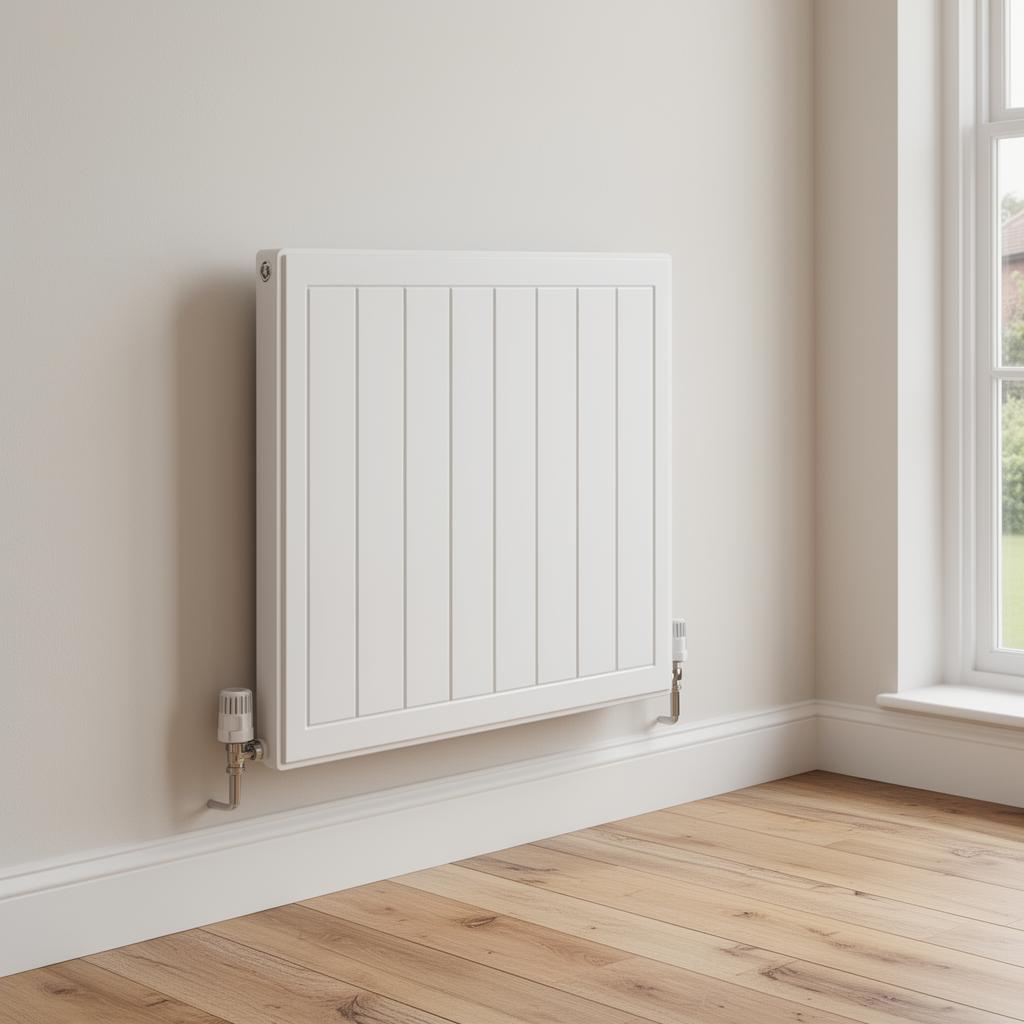
Running a boiler at a lower flow temperature — typically 55°C or below rather than the old default of 70-80°C — improves condensing efficiency measurably, but it also reduces the heat output of every radiator in the house, because a radiator's output falls roughly with the square of the temperature difference to the room. Radiators sized correctly for a 75°C flow can end up unable to heat the room properly at 55°C unless they're upsized or supplemented. We check each radiator against the lower design flow temperature before recommending it, and where a room falls short we look at whether a larger single panel, a double panel, or an additional radiator on that circuit closes the gap, rather than pushing the flow temperature back up and giving away the efficiency gain.
Pumped-oil versus gravity feed: does it matter?
Older oil systems sometimes still rely on gravity feed, where the tank sits higher than the burner and oil flows down to it under its own weight; a pumped system uses the burner's internal pump to draw oil up from a tank at any level, including below the boiler. Gravity feed limits where a tank can be sited and is more prone to airlocks if the line runs dry, while a pumped system is more flexible on tank position but needs the pipe run and lift height kept within the burner pump's rated capacity — usually no more than a few metres of lift and a set maximum run length. When we replace an oil boiler we check which type the existing tank and pipework support before assuming a straight swap, because a tank sited for gravity feed may need repositioning or a different pump to suit a modern burner.
Combi, system or regular: which suits the property?
A combi boiler heats water directly from the mains on demand with no cylinder or tank, which suits smaller households with modest simultaneous hot water demand and properties with no loft or airing cupboard space to spare. A system boiler heats a stored cylinder, giving stronger and more consistent flow to multiple outlets at once — better suited to larger households or properties with more than one bathroom — while a regular (open-vent) boiler additionally needs a cold feed and expansion tank, usually only chosen now where an existing system layout makes it the simpler swap. On stock like stone village homes the right answer depends on bathroom count and existing pipework layout as much as household size, which is why we ask about actual usage patterns rather than defaulting to whatever's currently fitted.
How a condensing boiler recovers extra heat
A condensing boiler passes flue gases through a secondary heat exchanger before they leave the flue, extracting additional heat by condensing water vapour in the exhaust back into liquid, which is expelled as the mildly acidic condensate water down the drain. This is why every condensing boiler needs a condensate drainage route as part of its installation, unlike older non-condensing boilers, which simply vented hot dry gas straight out. The efficiency benefit only fully materialises when the boiler is actually condensing regularly, which needs a return water temperature low enough — generally below 55°C — for water vapour to condense in the first place. A condensing boiler run permanently at a high flow temperature can spend much of its time not actually condensing, which is one of the main reasons flow temperature settings matter as much as the boiler model chosen.
Other boiler services in Compton Martin
- Gas Boiler Installation in Compton MartinGas Safe registered installations and upgrades for mains gas homes across Bath, Radstock and Wells.
- Oil Boiler Installation in Compton MartinOFTEC-trained oil boiler specialist for rural homes off the gas grid — tank and boiler replacements.
- Boiler Servicing in Compton MartinAnnual boiler services to keep your warranty valid and your home safe, efficient and warm.
- Maintenance & Repair in Compton MartinDiagnostics, repairs and breakdown call-outs for gas and oil boilers across BA and BS postcodes.
- Landlord Gas Safety Certificates in Compton MartinAnnual CP12 landlord gas safety records issued on the day, for single lets, HMOs, holiday lets and whole portfolios.
- Oil Boiler Servicing in Compton MartinOFTEC registered annual servicing for oil boilers, including nozzle, electrode, filter and smoke test work on off grid homes.
- Oil Boiler Repairs in Compton MartinOil boiler breakdown repairs across rural Somerset, from lockouts and sooting to pump, photocell and control faults.
- Oil Tank Replacement in Compton MartinBunded oil tank replacement and relocation with base preparation, new supply line and OFTEC paperwork on completion.
New Worcester boiler with a 10 year guarantee*
Free no-obligation quotes for installation, servicing & repairs across BA & BS postcodes.