
Gas Boiler Installation — Combe Hay (BA2)
Homeowners, landlords and smallholders tend to ask different questions about gas boiler installation: homeowners want comfort and running costs sorted, landlords need compliant paperwork they can hand to tenants and agents, and rural owners often need to weigh oil against other fuels. We cover all three from 24 Bristol Road, Radstock BA3 3EE as a Gas Safe registered and OFTEC registered firm, so the advice is tailored to what you actually need the system to do. Typical era of build is mixed-cottage, which affects existing pipework and system cleanliness. homes alongside small commercial and agricultural premises make up most enquiries from this postcode. In Combe Hay itself (BA2, Somerset) that usually means stone farmhouses and cottages, roughly 6 miles from the workshop.
Qualifications behind the work
Reg. 549918 — every gas job notified to Building Control and a CP12 issued where required.
Qualifies your install for the full 10-year manufacturer guarantee* on supported models.
362+ verified reviews from real customers across BA and BS postcodes.
No verbal-only quotes. You'll get the boiler model, controls and warranty in writing before we book.
Local conditions we plan around in BA2
Valley-floor properties in this area sometimes sit lower than the surrounding land, which can affect drainage for condensate pipework and, in a handful of cases, groundwater levels near where a boiler or cylinder is sited. It's not usually a major factor in a straightforward replacement, but it's worth checking as part of the survey, particularly for ground-floor plant rooms or utility cupboards in older cottages near a brook or river. Planning constraints are usually light here, so external work is checked first. Our van runs the B3110 to reach you, 6 miles out from the Radstock workshop. Combe Hay is roughly 6 miles from our Radstock base via the B3110. Typical property stock here: stone farmhouses and cottages. Combe Hay sits in the Somerset BA2 postcode and is part of our weekly run, so local response is quick. When we quote gas boiler installation here we factor in flue routing, condensate fall and gas-supply pipe sizing before the price is fixed.
The work, step by step
- Gas Safe registered engineers
- Free no-obligation quotes
- Smart heating controls fitted
- Conversions (regular to combi)
- Free written quote, no obligation
- Local aftercare from a 6-mile base
Also covering the lanes around Combe Hay
Beyond Combe Hay we're frequently on jobs in South Stoke (BA2), Englishcombe (BA2), Wellow (BA2) and Odd Down (BA2) — so spares, follow-ups and annual services are straightforward.
Combe Hay questions we get asked
- Is a boiler install a noisy, disruptive job?
- There's unavoidable noise — drilling for the flue, pipework, sometimes moving a cylinder — but a straightforward swap is usually done within a working day with the mess kept to the immediate work area. We dust-sheet the route in and out and clear away pipe offcuts and old parts before we leave.
- Is it worth upgrading the heating controls when we replace the boiler?
- Where the existing controls are an old mechanical timer and single room thermostat, replacing them alongside the boiler with weather compensation or a modern programmable thermostat usually improves comfort and efficiency more than the boiler swap alone. It's not compulsory, but it's often the single best-value addition to a new install.
- What's the difference between a power flush and a chemical flush?
- A chemical flush circulates a cleaning agent through the existing system to loosen light debris, while a power flush uses a pump to force water at higher velocity and reversed direction through radiators and pipework to shift heavier sludge. We usually recommend the more thorough power flush before connecting a new boiler to an older system.
- We've still got an old back boiler behind the fireplace — what's involved in removing it?
- Removing a back boiler means capping off the gas and water connections behind the fireplace, making good the opening or fitting a new fire/surround if you're keeping one, and rerouting pipework to the new combi or system boiler's position. It's more work than a like-for-like swap but a common upgrade on the older housing stock in this area.
- What actually happens on install day?
- The engineer isolates the gas or oil supply and water, removes the old boiler, fits and pressure-tests the new one, connects the flue and condensate, and commissions the system. For a straight swap this is usually one day; a conversion, relocation, or cylinder change can run into a second depending on the pipework involved.
- Is a magnetic filter really necessary, or is it an upsell?
- It's a genuine manufacturer requirement, not an add-on we invent — most boiler warranties are conditional on a system filter being fitted, particularly on hard water. The filter catches magnetite sludge and debris circulating in the system before it reaches the boiler's heat exchanger, which is what actually causes blockages and noise over time.
How to get this priced
Finishing gas boiler installation isn't the end of the relationship — if something doesn't feel right once the system's been running for a while, get in touch and we'll come back and look at it. Annual servicing afterwards keeps the guarantee valid and the system running as it should. A written quote follows the survey — no pressure, and no charge for the Combe Hay visit. Most of what we open up here is stone farmhouses and cottages, which dictates flue routes and pipe sizing. Planning constraints are usually light here, so external work is checked first.
The factual picture in Combe Hay
- County
- Somerset
- Postcode district
- BA2
- Settlement type
- village
- Nearest classified road
- B3110
- Distance from our base
- 6 miles (Radstock, BA3)
- Typical building stock
- stone farmhouses and cottages
- Water hardness
- very hard limestone water
- Fuel availability
- mains gas with off-grid pockets
- Customer mix
- homes alongside small commercial and agricultural premises
- Nearby areas covered
- South Stoke, Englishcombe, Wellow, Odd Down
The parts of the job people rarely mention
Electronic and physical scale reducers compared
In very hard limestone water areas like Combe Hay, a scale reducer fitted on the boiler's cold feed protects the heat exchanger without the ongoing salt and drainage requirements of a full water softener. Physical scale reducers use a polyphosphate or template-assisted crystallisation cartridge that alters how calcium carbonate crystallises so it's less likely to adhere to hot surfaces; electronic and electromagnetic devices claim a similar effect without a cartridge to replace, though the evidence base for electronic types is weaker and more inconsistent than for physical media. Manufacturers including Worcester Bosch now specify a scale reducer or softener as a condition of extended guarantees in hard water areas, so the choice affects warranty validity as well as long-term performance, not just descale frequency.
Chimney liners for boilers using an existing flue
Where an older boiler used the property's original brick or stone chimney as its flue route, a replacement condensing boiler usually can't use the same masonry flue unlined, because the flue gases are cooler and wetter and will attack unprotected brickwork and mortar over time. A correctly specified stainless steel liner, sized to the boiler manufacturer's flue length and diameter tables, carries the flue gases safely and lets the existing chimney be reused rather than needing a new wall or roof penetration — often the only realistic option on a listed or solid-wall property in Combe Hay where an external flue run isn't permitted. The liner has to be inspected and swept as part of ongoing servicing exactly as an open-fire flue would be, which is easy to overlook once it's hidden inside the chimney.
LPG as an alternative to oil off the gas grid
Properties around Combe Hay that sit off the mains gas network aren't limited to oil — bulk LPG, stored in an above-ground tank on a concrete base with the same OFTEC-style clearance and access rules as oil, runs standard gas-rated boilers with only a change of injector and pressure setting rather than a different boiler entirely. It suits households that want a gas hob and gas-style modulation rather than an oil burner's on/off firing pattern. The tank still needs delivery access for a tanker, which on some rural driveways is the deciding factor over oil. We check the access route for the largest realistic delivery vehicle before recommending LPG over oil, because a tank that can't be filled easily causes more disruption than the fuel choice was meant to solve.
Combe Hay's place within the wider Somerset area we cover
Combe Hay is one of several neighbourhoods we work in around the wider area, and while the postcode district and general water hardness and building stock trends are shared with the surrounding district, the specific street-level access, parking and property type still varies enough locally that we treat each visit on its own facts rather than applying a generic area answer. Nearby areas we also cover include South Stoke, Englishcombe and Wellow, which is relevant mainly where a customer wants comparable jobs referenced or where a single visit can sensibly cover more than one nearby property in the same trip. The underlying trade standards — Gas Safe, OFTEC, correct commissioning — don't vary by neighbourhood, only the practical details of the job do.
Single-pipe circuits in older stone cottages
A lot of the stone cottages and farmhouses around Combe Hay were plumbed decades ago on a single-pipe gravity circuit, where each radiator draws from and returns to the same loop rather than having its own flow and return. It works, but radiators furthest from the boiler receive water that's already cooled after giving up heat to the ones before it, so the far end of the house is always the coldest. Converting to a two-pipe layout means new pipe runs, which in a stone cottage often means chasing lime plaster or lifting flagstones — not a trivial job. Where a full rewire of the pipework isn't wanted, we sometimes improve balance instead by oversizing the radiators nearest the end of the run and fitting TRVs to hold back the ones nearest the boiler.
Common boiler fault codes and what usually causes them
Most modern boilers display a fault code on the control panel when they lock out, and while the exact code differs between manufacturers, the underlying causes cluster into a small number of categories: low system pressure (often from a small leak or after bleeding radiators), ignition failure (a worn electrode, gas supply issue, or blocked condensate causing a safety shutdown), or a failed sensor reporting an implausible temperature reading. A condensate blockage or freeze specifically tends to show a distinct code from a genuine ignition fault, which is why checking the external condensate pipe for ice before calling out an engineer in a cold snap can sometimes resolve the issue without a visit at all. We ask for the exact fault code and any recent history — a bled radiator, a cold snap, a recent service — before attending, since it often narrows down the likely cause before we arrive.
Signs a boiler repair is no longer the right call
A boiler that's failing repeatedly, needing a different part replaced every service, or over roughly ten to fifteen years old is approaching the point where continued repair costs more over time than replacement, particularly once a heat exchanger — the most expensive single part — starts to show signs of failure through leaks or reduced output. Efficiency is the other half of the calculation: an older non-condensing boiler running at 70-80% efficiency against a modern condensing combi at over 90% means a meaningful chunk of every unit of fuel burned in the old boiler is simply lost up the flue. We give a straight answer on repair versus replace based on the fault found and the boiler's age and condition, rather than defaulting to whichever is more profitable to us on the day.
Other boiler services in Combe Hay
- Boiler Installation in Combe HayNew combi, system and regular boiler installations for gas and oil homes — fixed prices, manufacturer warranties.
- Oil Boiler Installation in Combe HayOFTEC-trained oil boiler specialist for rural homes off the gas grid — tank and boiler replacements.
- Boiler Servicing in Combe HayAnnual boiler services to keep your warranty valid and your home safe, efficient and warm.
- Maintenance & Repair in Combe HayDiagnostics, repairs and breakdown call-outs for gas and oil boilers across BA and BS postcodes.
- Landlord Gas Safety Certificates in Combe HayAnnual CP12 landlord gas safety records issued on the day, for single lets, HMOs, holiday lets and whole portfolios.
- Oil Boiler Servicing in Combe HayOFTEC registered annual servicing for oil boilers, including nozzle, electrode, filter and smoke test work on off grid homes.
- Oil Boiler Repairs in Combe HayOil boiler breakdown repairs across rural Somerset, from lockouts and sooting to pump, photocell and control faults.
- Oil Tank Replacement in Combe HayBunded oil tank replacement and relocation with base preparation, new supply line and OFTEC paperwork on completion.
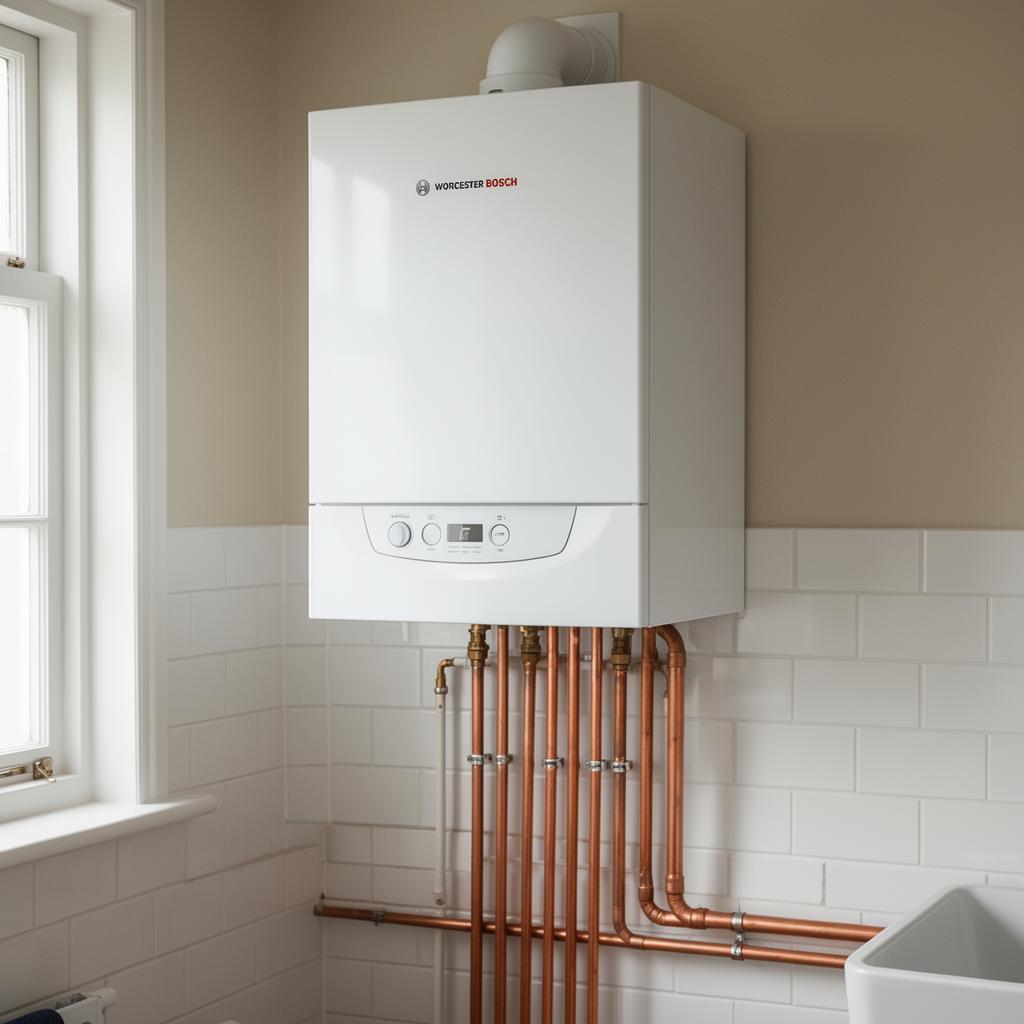
New Worcester boiler with a 10 year guarantee*
Free no-obligation quotes for installation, servicing & repairs across BA & BS postcodes.