
Boiler Replacement Quote, New Boiler Quote, Faulkland — No Obligation
Working across Radstock, Bath and the surrounding Mendip villages day to day means we see plenty of variation in how boiler replacement quote needs to be approached — different building ages, different water supplies, different access. That local experience feeds into how we survey and quote, rather than working from a single generic template. Gas Safe registered, OFTEC registered, 24 Bristol Road, Radstock BA3 3EE. Most of what we open up here is stone cottages and farms, which dictates flue routes and pipe sizing. Mains gas covers much of the area, with off-grid pockets, which changes the appliance shortlist. In Faulkland itself (BA3, Somerset) that usually means stone cottages and farms, roughly 3 miles from the workshop.
Being close to our Radstock base means straightforward logistics for a job here — quick access for the survey, easy return visits if anything needs revisiting, and no long travel factored into how the work is scheduled. That doesn't change the standard of the work itself, but it does tend to make arranging visits and follow-ups a bit more flexible than for properties further out toward the edge of the area we cover. Most of what we open up here is stone cottages and farms, which dictates flue routes and pipe sizing. Water here is very hard limestone water, so scale protection is specified accordingly. Boiler replacements in Faulkland are shaped by the property stock here — stone cottages and farms. We plan flue, condensate and controls around the building before we put a number on the page.
Registrations and how work is signed off
Boiler, controls, flue, warranty terms, flush spec — all in writing before you commit.
Free, no-pressure 20-minute visit — measured up properly so the price is fixed, not estimated.
We don't ask for money up front. Pay on completion when the system is signed off.
We're 24 Bristol Rd, Radstock — you'll deal with the same team for any aftercare.
Local conditions we plan around in BA3
Being close to our Radstock base means straightforward logistics for a job here — quick access for the survey, easy return visits if anything needs revisiting, and no long travel factored into how the work is scheduled. That doesn't change the standard of the work itself, but it does tend to make arranging visits and follow-ups a bit more flexible than for properties further out toward the edge of the area we cover. Most of what we open up here is stone cottages and farms, which dictates flue routes and pipe sizing. Water here is very hard limestone water, so scale protection is specified accordingly. Boiler replacements in Faulkland are shaped by the property stock here — stone cottages and farms. We plan flue, condensate and controls around the building before we put a number on the page.
Questions to ask any quoting engineer — Faulkland
- Are they on the Gas Safe register? (Ask for the reg number)
- Is the price fixed or estimated?
- Is the boiler accredited so you get the full warranty?
- Who handles aftercare if something goes wrong?
- Will they leave the site clean?
Neighbouring Somerset areas we serve
We cover Faulkland alongside Hemington (BA3), Norton St Philip (BA2), Shoscombe (BA2), Kilmersdon (BA3) — so spares, follow-ups and annual visits are easy to schedule together.
Straight answers for Faulkland homeowners
- Could we switch from oil to mains gas if it's nearby?
- It depends entirely on whether a gas main actually runs past the property — some parts of the Somerset patch we cover have gas on one side of the road and none on the other. We can check with the network on request; if it's there, a conversion is a bigger job than a swap but often worthwhile long-term.
- What's the difference between a power flush and a chemical flush?
- A chemical flush circulates a cleaning agent through the existing system to loosen light debris, while a power flush uses a pump to force water at higher velocity and reversed direction through radiators and pipework to shift heavier sludge. We usually recommend the more thorough power flush before connecting a new boiler to an older system.
- Do I need to do anything to activate my boiler's warranty?
- As a Worcester Bosch Accredited Installer we register qualifying Worcester installs on your behalf, which is what unlocks the extended guarantee (up to 10 years* on qualifying installs) rather than the standard shorter term. For other brands we still register the installation; keep the confirmation with your other paperwork in case you need it.
- What's a CP12 and do I need one as a landlord?
- A CP12 (Landlord Gas Safety Record) confirms every gas appliance in a rented property has passed an annual safety check by a Gas Safe registered engineer. It's a legal requirement before letting and at each renewal, a copy has to go to tenants, and it needs to be renewed every 12 months without a gap.
- Who actually carries out the work?
- A Gas Safe and, where relevant, OFTEC registered engineer from our own small team carries out the job — we don't sub the install out to a third party after quoting. You deal with the same people from survey through to commissioning and any aftercare calls.
- Can I get a quote for nearby Hemington and Norton St Philip too?
- Yes — we cover Hemington and Norton St Philip on the same patch. Same response time, same pricing approach.
Local reference data
- County
- Somerset
- Postcode district
- BA3
- Settlement type
- village
- Nearest classified road
- A366
- Distance from our base
- 3 miles (Radstock, BA3)
- Typical building stock
- stone cottages and farms
- Water hardness
- very hard limestone water
- Fuel availability
- mains gas with off-grid pockets
- Customer mix
- homes alongside small commercial and agricultural premises
- Nearby areas covered
- Hemington, Norton St Philip, Shoscombe, Kilmersdon
Technical notes for this job type
Common boiler fault codes and what usually causes them
Most modern boilers display a fault code on the control panel when they lock out, and while the exact code differs between manufacturers, the underlying causes cluster into a small number of categories: low system pressure (often from a small leak or after bleeding radiators), ignition failure (a worn electrode, gas supply issue, or blocked condensate causing a safety shutdown), or a failed sensor reporting an implausible temperature reading. A condensate blockage or freeze specifically tends to show a distinct code from a genuine ignition fault, which is why checking the external condensate pipe for ice before calling out an engineer in a cold snap can sometimes resolve the issue without a visit at all. We ask for the exact fault code and any recent history — a bled radiator, a cold snap, a recent service — before attending, since it often narrows down the likely cause before we arrive.
Oil tank de-sludging: why it's not optional
Oil sitting in a tank for years accumulates water from condensation and fine sediment that settles at the bottom, and over time this forms a sludge layer that can be drawn into the fuel line, particularly when the tank is nearly empty and the outlet pulls from lower in the tank than usual. Sludge blocks fine oil filters and burner nozzles, which shows up as burner lockouts or a boiler that won't fire cleanly rather than as an obvious tank problem. De-sludging drains and cleans the tank base without necessarily removing the whole tank, and it's worth doing when a tank is inherited with a property, before switching to a new boiler, or if lockouts recur despite the filter and nozzle being replaced. It's a preventative job that's cheaper done on schedule than after a burner failure it caused.
Pumped-oil versus gravity feed: does it matter?
Older oil systems sometimes still rely on gravity feed, where the tank sits higher than the burner and oil flows down to it under its own weight; a pumped system uses the burner's internal pump to draw oil up from a tank at any level, including below the boiler. Gravity feed limits where a tank can be sited and is more prone to airlocks if the line runs dry, while a pumped system is more flexible on tank position but needs the pipe run and lift height kept within the burner pump's rated capacity — usually no more than a few metres of lift and a set maximum run length. When we replace an oil boiler we check which type the existing tank and pipework support before assuming a straight swap, because a tank sited for gravity feed may need repositioning or a different pump to suit a modern burner.
Radiator sizing after lowering the flow temperature
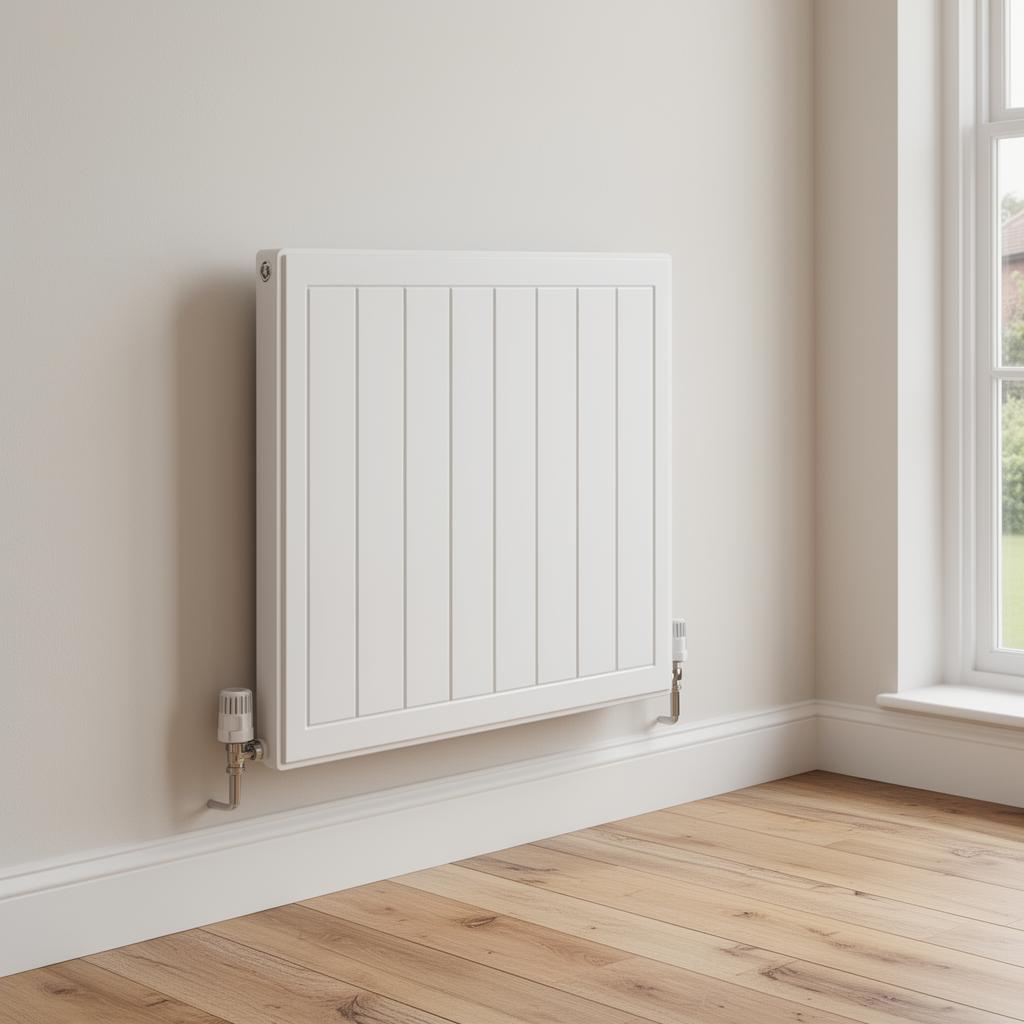
Running a boiler at a lower flow temperature — typically 55°C or below rather than the old default of 70-80°C — improves condensing efficiency measurably, but it also reduces the heat output of every radiator in the house, because a radiator's output falls roughly with the square of the temperature difference to the room. Radiators sized correctly for a 75°C flow can end up unable to heat the room properly at 55°C unless they're upsized or supplemented. We check each radiator against the lower design flow temperature before recommending it, and where a room falls short we look at whether a larger single panel, a double panel, or an additional radiator on that circuit closes the gap, rather than pushing the flow temperature back up and giving away the efficiency gain.
How a condensing boiler recovers extra heat
A condensing boiler passes flue gases through a secondary heat exchanger before they leave the flue, extracting additional heat by condensing water vapour in the exhaust back into liquid, which is expelled as the mildly acidic condensate water down the drain. This is why every condensing boiler needs a condensate drainage route as part of its installation, unlike older non-condensing boilers, which simply vented hot dry gas straight out. The efficiency benefit only fully materialises when the boiler is actually condensing regularly, which needs a return water temperature low enough — generally below 55°C — for water vapour to condense in the first place. A condensing boiler run permanently at a high flow temperature can spend much of its time not actually condensing, which is one of the main reasons flow temperature settings matter as much as the boiler model chosen.
Electronic and physical scale reducers compared
In very hard limestone water areas like Faulkland, a scale reducer fitted on the boiler's cold feed protects the heat exchanger without the ongoing salt and drainage requirements of a full water softener. Physical scale reducers use a polyphosphate or template-assisted crystallisation cartridge that alters how calcium carbonate crystallises so it's less likely to adhere to hot surfaces; electronic and electromagnetic devices claim a similar effect without a cartridge to replace, though the evidence base for electronic types is weaker and more inconsistent than for physical media. Manufacturers including Worcester Bosch now specify a scale reducer or softener as a condition of extended guarantees in hard water areas, so the choice affects warranty validity as well as long-term performance, not just descale frequency.
Your next move in BA3
For rural and off-grid properties, boiler replacement quote often involves oil rather than mains gas, so mention your current fuel and tank setup when you call. Being OFTEC registered as well as Gas Safe registered means we can quote for either without treating oil as a specialist add-on. Gas work is signed off Gas Safe; oil work is signed off OFTEC. Terrain is level, which matters for condensate runs and tank siting. Typical era of build is mixed-cottage, which affects existing pipework and system cleanliness.
Related help for Faulkland
- New Boiler Cost in FaulklandHonest, area-specific pricing guidance for a new combi, system or oil boiler — with no obligation site visit.
- Emergency Boiler Repair in FaulklandSame-week (often same-day) no-heat and no-hot-water call-outs for gas and oil boilers.
- Landlord Gas Safety Certificate (CP12) in FaulklandAnnual CP12 inspections for landlords and letting agents — digital certificate the same day.
- Oil Boiler Service Cost in FaulklandWhat an OFTEC registered oil boiler service costs locally, what is included, and what a tank inspection adds.
- Oil Boiler Repair in FaulklandOil boiler lockouts, sooting and no heat call outs for homes off the mains gas grid, diagnosed before parts are quoted.
- Boiler Service Cost in FaulklandAnnual gas boiler service pricing, what the check covers, and how a landlord certificate can be combined in one visit.
- Boiler Installation in FaulklandNew combi, system and regular boiler installations for gas and oil homes — fixed prices, manufacturer warranties.
- Gas Boiler Installation in FaulklandGas Safe registered installations and upgrades for mains gas homes across Bath, Radstock and Wells.
New Worcester boiler with a 10 year guarantee*
Free no-obligation quotes for installation, servicing & repairs across BA & BS postcodes.