
Oil Boiler Service Cost, How Much Is a New Boiler in Holcombe?
Some properties make oil boiler service cost straightforward; others need a bit more thought about parking, access to the boiler cupboard, or how equipment gets in and out. We factor that into the visit rather than discovering it on the day. Working from 24 Bristol Road, Radstock BA3 3EE across the Radstock, Bath and Mendip area, we're Gas Safe registered and OFTEC registered, so both mains gas and oil-fired work is covered under one roof. Our van runs the A367 to reach you, 3 miles out from the Radstock workshop. Planning constraints are usually light here, so external work is checked first. In Holcombe itself (BA3, Somerset) that usually means stone village homes and modern estates, roughly 3 miles from the workshop.
Stone cottages and farmhouses around here were mostly built long before central heating existed, so pipework and boiler locations have usually been retrofitted at some point, sometimes more than once. Thick stone walls, uneven floor levels and low ceilings can all affect where a boiler or cylinder can practically go, and older stonework doesn't always take fixings the way modern block or brick does. We work around those constraints on site rather than assuming a straightforward install. Nearest neighbours on our round are Stratton-on-the-Fosse, Chilcompton, Coleford. Most of what we open up here is stone village homes and modern estates, which dictates flue routes and pipe sizing. What changes a new boiler price in Holcombe more than the brand is the building itself: stone village homes and modern estates drive different flue routes, gas-pipe sizing and controls choices. That's why we visit before fixing a price.
What changes the price — Holcombe
- Boiler type (combi vs system vs regular)
- Flue route and length
- Gas / oil supply pipe sizing
- Controls (basic, smart, weather-comp)
- Power-flush vs chemical clean
- Condensate routing and any external works
Qualifications behind the work
No verbal-only quotes — every figure is in writing with the boiler, controls and warranty spelled out.
362+ verified reviews from real customers across BA and BS postcodes.
Our engineers aren't paid on what you buy — there's no incentive to upsell you to a bigger boiler.
Qualifies your install for the full 10-year manufacturer guarantee* on supported models.
Neighbouring Somerset areas we serve
We cover Holcombe alongside Stratton-on-the-Fosse (BA3), Chilcompton (BA3), Coleford (BA3), Kilmersdon (BA3) — so spares, follow-ups and annual visits are easy to schedule together.
How Somerset building stock shapes the spec
Stone cottages and farmhouses around here were mostly built long before central heating existed, so pipework and boiler locations have usually been retrofitted at some point, sometimes more than once. Thick stone walls, uneven floor levels and low ceilings can all affect where a boiler or cylinder can practically go, and older stonework doesn't always take fixings the way modern block or brick does. We work around those constraints on site rather than assuming a straightforward install. Nearest neighbours on our round are Stratton-on-the-Fosse, Chilcompton, Coleford. Most of what we open up here is stone village homes and modern estates, which dictates flue routes and pipe sizing. What changes a new boiler price in Holcombe more than the brand is the building itself: stone village homes and modern estates drive different flue routes, gas-pipe sizing and controls choices. That's why we visit before fixing a price.
Common queries, answered honestly
- What's a CP12 and do I need one as a landlord?
- A CP12 (Landlord Gas Safety Record) confirms every gas appliance in a rented property has passed an annual safety check by a Gas Safe registered engineer. It's a legal requirement before letting and at each renewal, a copy has to go to tenants, and it needs to be renewed every 12 months without a gap.
- What are your opening hours, and can you help out of hours?
- Our published hours are Monday to Friday, 8:30am to 5pm, and that's when the phones are answered and jobs are booked. We're honest that we don't run a round-the-clock emergency line, so if you're planning ahead, call during those hours on 07516 118198 and we'll get you booked in.
- What paperwork do I get once the job's finished?
- You'll get a Benchmark commissioning checklist for the boiler, a building notice or Building Control completion certificate for notifiable work, manufacturer warranty registration confirmation, and a Gas Safe (or OFTEC) record of the work. Keep these together — they're what a future buyer's solicitor or a warranty claim will ask for.
- Is a boiler install a noisy, disruptive job?
- There's unavoidable noise — drilling for the flue, pipework, sometimes moving a cylinder — but a straightforward swap is usually done within a working day with the mess kept to the immediate work area. We dust-sheet the route in and out and clear away pipe offcuts and old parts before we leave.
- We've got an oil-fired Rayburn or Aga heating the house — can that be replaced with a standard boiler?
- Yes, where a range cooker like a Rayburn or Aga is also running the central heating, it can be separated out and replaced with a dedicated modern oil or LPG boiler, keeping the range purely for cooking if you want to retain it, or removing it entirely. Sizing the new boiler correctly for the property is the key part of getting this right.
- Why do quotes vary so much in BA3?
- Because the install matters more than the boiler. Two Holcombe homes can have very different gas pipe sizes, flue routes and condensate runs — that's where the cost really moves.
Coverage detail for BA3
- County
- Somerset
- Postcode district
- BA3
- Settlement type
- village
- Nearest classified road
- A367
- Distance from our base
- 3 miles (Radstock, BA3)
- Typical building stock
- stone village homes and modern estates
- Water hardness
- very hard limestone water
- Fuel availability
- mains gas with off-grid pockets
- Customer mix
- homes alongside small commercial and agricultural premises
- Nearby areas covered
- Stratton-on-the-Fosse, Chilcompton, Coleford, Kilmersdon
Practical considerations across BA3
What different boiler noises usually mean
A kettling or rumbling sound from a boiler is most often scale or sludge build-up on the heat exchanger causing localised boiling as water is trapped and overheated in restricted channels — the heating equivalent of a kettle furring up. A banging or knocking sound in pipework, sometimes called water hammer, is usually caused by a valve closing too quickly or trapped air rather than the boiler itself. A whining or humming sound tends to point to the circulating pump, either from wear or from air in the system reducing lubrication at the bearing. Diagnosing correctly from the noise alone isn't reliable enough to act on without checking system pressure, inhibitor condition and the pump directly, but the noise itself is a useful first indicator of which of those to check first.
LPG as an alternative to oil off the gas grid
Properties around Holcombe that sit off the mains gas network aren't limited to oil — bulk LPG, stored in an above-ground tank on a concrete base with the same OFTEC-style clearance and access rules as oil, runs standard gas-rated boilers with only a change of injector and pressure setting rather than a different boiler entirely. It suits households that want a gas hob and gas-style modulation rather than an oil burner's on/off firing pattern. The tank still needs delivery access for a tanker, which on some rural driveways is the deciding factor over oil. We check the access route for the largest realistic delivery vehicle before recommending LPG over oil, because a tank that can't be filled easily causes more disruption than the fuel choice was meant to solve.
Wood-burning stoves with a back boiler alongside a main boiler
Some older rural properties around Holcombe run a wood-burning stove with a back boiler feeding heat into the same central heating circuit as an oil or gas boiler, usually through a thermal store or a cylinder with two coils. Getting this combination to work safely means the stove's back boiler circuit has its own means of dissipating heat if the pump fails or a valve closes while the stove is still burning — a stove can't simply be switched off the way a boiler can if its heat has nowhere to go, so a gravity-fed safety circuit or heat leak radiator is normally required. It's a more involved design than a single-boiler system and needs planning at the point either appliance is replaced, not treated as an afterthought once the new boiler is already fitted.
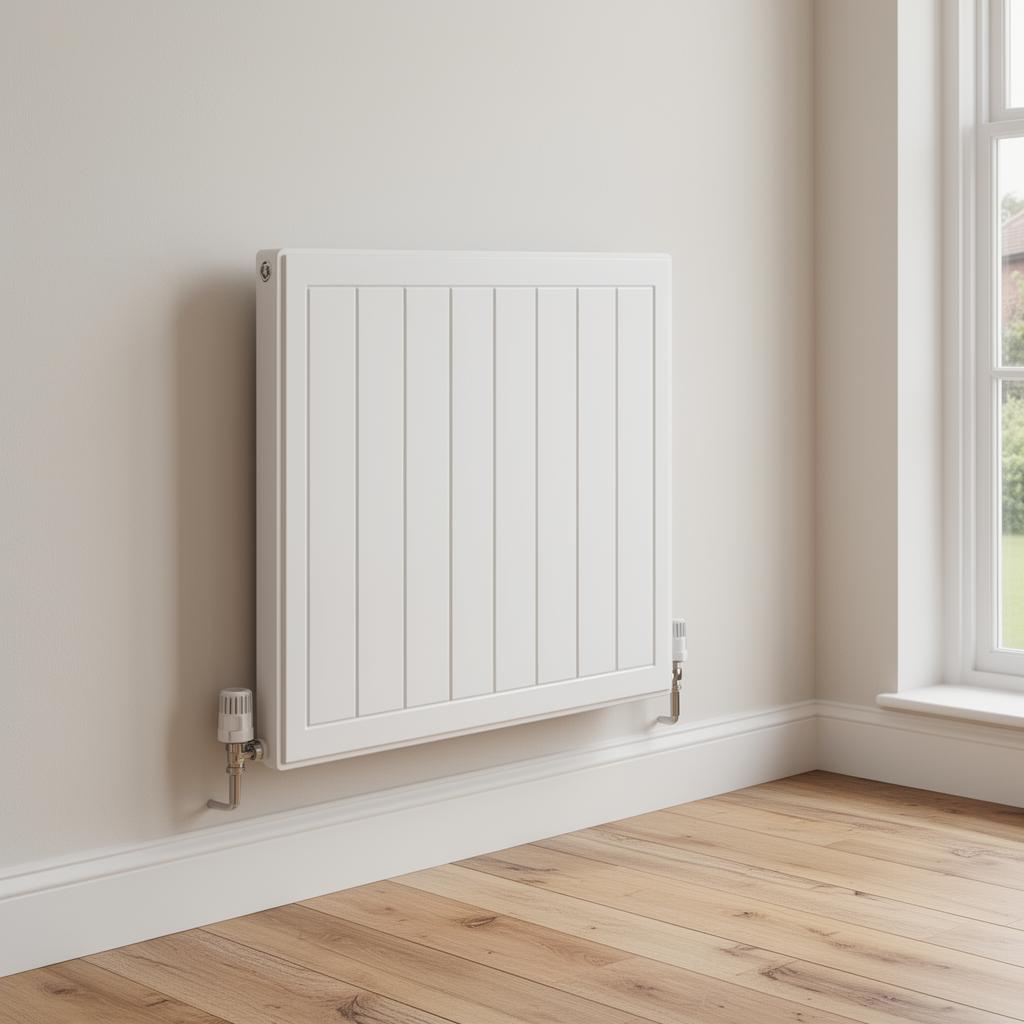
Radiator sizing after lowering the flow temperature
Running a boiler at a lower flow temperature — typically 55°C or below rather than the old default of 70-80°C — improves condensing efficiency measurably, but it also reduces the heat output of every radiator in the house, because a radiator's output falls roughly with the square of the temperature difference to the room. Radiators sized correctly for a 75°C flow can end up unable to heat the room properly at 55°C unless they're upsized or supplemented. We check each radiator against the lower design flow temperature before recommending it, and where a room falls short we look at whether a larger single panel, a double panel, or an additional radiator on that circuit closes the gap, rather than pushing the flow temperature back up and giving away the efficiency gain.
Nozzle replacement and baffle cleaning on oil burners
An oil burner's nozzle atomises fuel into a fine spray for combustion, and it wears from constant fuel flow at pressure, gradually changing the spray pattern away from the burner manufacturer's specification even before it visibly fails. A worn nozzle burns less cleanly, producing more soot that coats the heat exchanger's baffles, and a sooted heat exchanger loses efficiency in the same way scale does on a gas boiler's plates. Standard practice on an annual oil service is to replace the nozzle as a matter of course, rather than wait for a fault, and to remove and clean the baffles so the heat exchanger surfaces are exposed to combustion heat properly again. Skipping nozzle replacement to save a service visit's minor parts cost is a false economy against the fuel wasted by a poorly atomising burner.
What a proper heating quote should include
A quote worth relying on states the specific boiler or equipment model, the labour and materials it covers, whether a system flush and magnetic filter are included, what happens to old equipment removal and disposal, and what's excluded — an unexpected gas pipe upsizing or asbestos-containing material discovered during removal, for example, which can't always be known before work starts. It should also state who's completing the Gas Safe or OFTEC notification and Benchmark commissioning record, since that's the paperwork that protects both the manufacturer's guarantee and the property's compliance history when it's sold. A vague one-line quote makes comparing genuinely different offers difficult, because two prices that look similar can cover very different scopes of actual work.
- Specific make and model, not just "combi boiler"
- Flush and magnetic filter stated as included or excluded
- Old equipment removal and disposal covered
- Notification and Benchmark record responsibility stated
Chasing pipework into lime plaster and stone walls
Solid stone or cob walls finished in lime plaster, common in the older parts of Holcombe, behave very differently to modern plasterboard when a pipe run needs chasing in. Lime plaster is softer and more porous than gypsum, so cutting a neat, consistent chase without blowing the surface needs a slower hand and finer disc than a stud-wall job, and any repair has to be made good in a lime-based skim rather than modern filler, which can trap moisture behind it and cause the patch to fail. On solid stone we sometimes surface-mount pipework in painted conduit instead of chasing, particularly where the wall is a significant structural thickness and chasing would weaken it. Knowing which approach a wall needs before starting avoids expensive plaster damage.
Oil tank de-sludging: why it's not optional
Oil sitting in a tank for years accumulates water from condensation and fine sediment that settles at the bottom, and over time this forms a sludge layer that can be drawn into the fuel line, particularly when the tank is nearly empty and the outlet pulls from lower in the tank than usual. Sludge blocks fine oil filters and burner nozzles, which shows up as burner lockouts or a boiler that won't fire cleanly rather than as an obvious tank problem. De-sludging drains and cleans the tank base without necessarily removing the whole tank, and it's worth doing when a tank is inherited with a property, before switching to a new boiler, or if lockouts recur despite the filter and nozzle being replaced. It's a preventative job that's cheaper done on schedule than after a burner failure it caused.
Booking work in Holcombe
If you've got questions about oil boiler service cost before committing to a survey — about fuel choice, likely disruption, or what's actually involved — call 07516 118198 and ask. You don't need to book anything to have that conversation first. A written quote follows the survey — no pressure, and no charge for the Holcombe visit. Planning constraints are usually light here, so external work is checked first. homes alongside small commercial and agricultural premises make up most enquiries from this postcode.
Related help for Holcombe
- New Boiler Cost in HolcombeHonest, area-specific pricing guidance for a new combi, system or oil boiler — with no obligation site visit.
- Emergency Boiler Repair in HolcombeSame-week (often same-day) no-heat and no-hot-water call-outs for gas and oil boilers.
- Landlord Gas Safety Certificate (CP12) in HolcombeAnnual CP12 inspections for landlords and letting agents — digital certificate the same day.
- Boiler Replacement Quote in HolcombeFree, no-obligation site visits and written specifications for old boiler replacements.
- Oil Boiler Repair in HolcombeOil boiler lockouts, sooting and no heat call outs for homes off the mains gas grid, diagnosed before parts are quoted.
- Boiler Service Cost in HolcombeAnnual gas boiler service pricing, what the check covers, and how a landlord certificate can be combined in one visit.
- Boiler Installation in HolcombeNew combi, system and regular boiler installations for gas and oil homes — fixed prices, manufacturer warranties.
- Gas Boiler Installation in HolcombeGas Safe registered installations and upgrades for mains gas homes across Bath, Radstock and Wells.
New Worcester boiler with a 10 year guarantee*
Free no-obligation quotes for installation, servicing & repairs across BA & BS postcodes.