
Local Gas Boiler Installation for Chew Magna
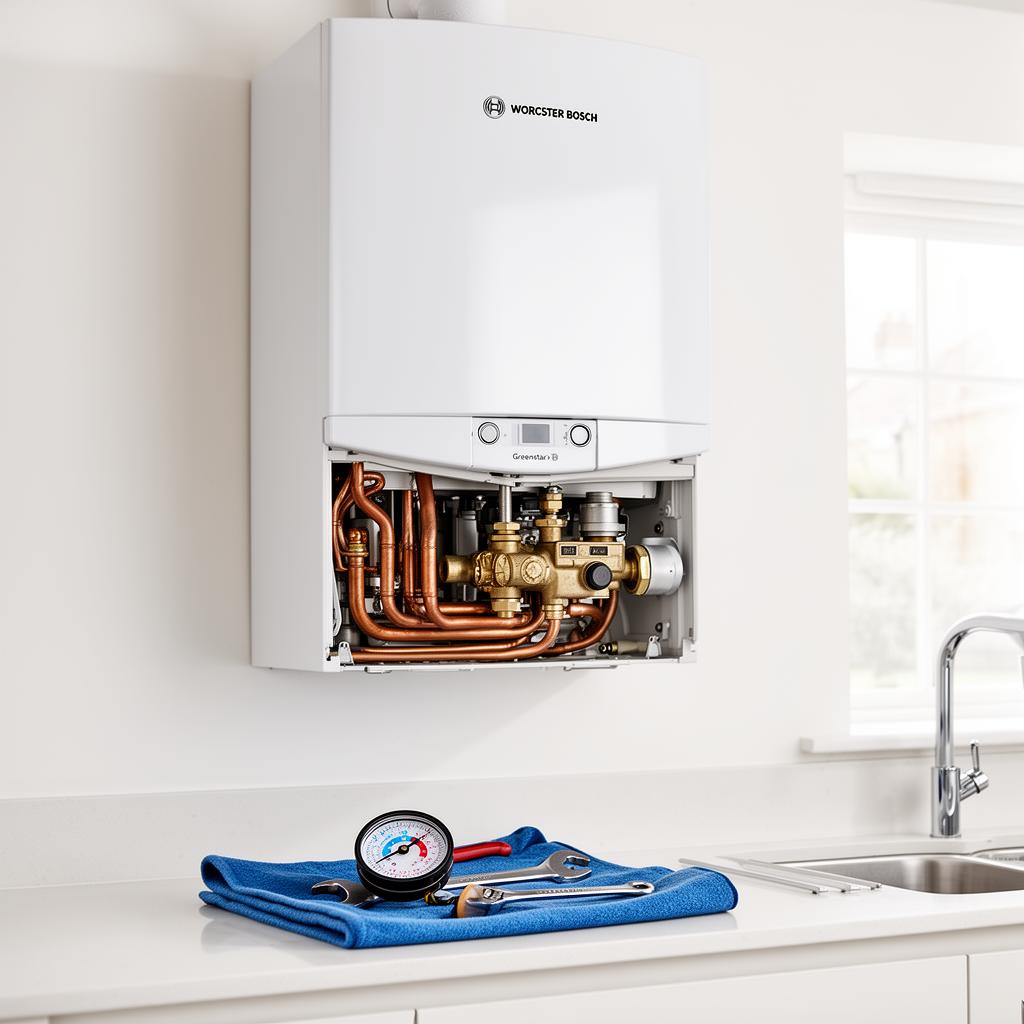
When you're comparing tradespeople for gas boiler installation, it's worth checking registration before price: Gas Safe for mains gas work, OFTEC for oil, and manufacturer accreditation if a specific guarantee matters to you. We hold all three — Gas Safe, OFTEC and Worcester Bosch Accredited Installer status — and work from 24 Bristol Road, Radstock BA3 3EE, so you can check us against whatever criteria you're using to shortlist. Most of what we open up here is stone village homes and georgian houses, which dictates flue routes and pipe sizing. Our van runs the B3130 to reach you, 8 miles out from the Radstock workshop. In Chew Magna itself (BS40, North Somerset) that usually means stone village homes and georgian houses, roughly 8 miles from the workshop.
Local conditions we plan around in BS40
The water supply in this part of the Chew Valley and surrounding area is hard, sitting between the very hard limestone water closer to Bath and the moderately hard supply further out. It's still enough to affect scale build-up over time, particularly in hot water cylinders and combi heat exchangers. We take that into account when specifying protection for a new system rather than assuming the same setup that works on a soft-water supply elsewhere in the country will perform the same way here. Water here is hard water, so scale protection is specified accordingly. Conservation and listed constraints apply to parts of the area, so external work is checked first. Chew Magna is roughly 8 miles from our Radstock base via the B3130. Typical property stock here: stone village homes and Georgian houses. Mains gas covers most of Chew Magna, so the usual choice is between a modern combi or a system boiler with a cylinder — we'll size it correctly for the home, not just swap like-for-like. When we quote gas boiler installation here we factor in flue routing, condensate fall and gas-supply pipe sizing before the price is fixed.
Within reach of the B3130
Beyond Chew Magna we're frequently on jobs in Chew Stoke (BS40), Stanton Drew (BS39), Winford (BS40) and Compton Martin (BS40) — so spares, follow-ups and annual services are straightforward.
Scope of work, itemised
- Gas Safe registered engineers
- Free no-obligation quotes
- Smart heating controls fitted
- Conversions (regular to combi)
- Free written quote, no obligation
- Local aftercare from a 8-mile base
What backs up a Chew Magna quote
Qualifies your install for the full 10-year manufacturer guarantee* on supported models.
Reg. 549918 — every gas job notified to Building Control and a CP12 issued where required.
Oil boilers, oil tanks and pipework — fully certified for off-grid installs and replacements.
362+ verified reviews from real customers across BA and BS postcodes.
Questions before you book
- How often should a boiler actually be serviced?
- Once a year is the standard recommendation from every manufacturer, and most warranty terms make it a condition rather than a suggestion — miss a year and a claim can be refused even if the fault is unrelated. Landlords have a separate legal duty to have gas appliances checked annually regardless of warranty terms.
- Does my new boiler need to be notified to Building Control?
- Yes — boiler installation and replacement is notifiable work under Building Regulations. As Gas Safe/OFTEC registered installers we self-certify the work through our Competent Person Scheme, which means we notify it directly and you get a certificate without needing to involve the council separately.
- What's different about heating a Georgian townhouse compared to a modern home?
- Georgian townhouses typically have tall rooms, solid walls, and long pipe runs between floors, which affects both heat loss calculations and boiler sizing — undersizing the boiler or radiators for the room volume is a common mistake. Flue routing also needs care given the height of the building and the appearance rules that often apply to the facade.
- Our houses are close together — are there rules about where a flue can go?
- Yes, flue terminal positions are governed by set minimum distances from windows, doors, boundaries, and other flues, including a neighbour's opening windows. On terraced and closely built streets this sometimes limits where a boiler can go or means routing the flue differently to an old back boiler's position — we check this at survey, not after ordering.
- What's actually checked during an annual boiler service?
- A service includes a visual and functional check of the boiler's casing and controls, flue gas analysis to confirm safe and efficient combustion, checking the flame picture and pressure, inspecting seals and condensate, and testing safety devices. It's a safety check as much as a performance one, and it's what keeps most manufacturer warranties valid.
- Is there mains gas across Chew Magna?
- Most of Chew Magna is on mains gas, though pockets towards Chew Stoke and Stanton Drew can be off-grid. We'll confirm what's at the property as part of the survey.
Next step for Chew Magna
Once gas boiler installation is complete, you'll have the documentation that goes with it — commissioning records and, where applicable, Gas Safe or OFTEC paperwork and manufacturer registration for the guarantee. Keep it somewhere safe; it's what an agent, buyer or insurer will ask to see later. We can usually pair the visit with other work in Chew Stoke to keep the trip efficient. Access is narrow terrace, so parking, spoil removal and delivery timing get planned in advance. Water here is hard water, so scale protection is specified accordingly.
Chew Magna coverage and distances
- County
- North Somerset
- Postcode district
- BS40
- Settlement type
- town
- Nearest classified road
- B3130
- Distance from our base
- 8 miles (Radstock, BA3)
- Typical building stock
- stone village homes and Georgian houses
- Water hardness
- hard water
- Fuel availability
- mains gas across most of the area
- Customer mix
- a mix of owner-occupied and rented homes
- Nearby areas covered
- Chew Stoke, Stanton Drew, Winford, Compton Martin
Things we check around Chew Magna
Chasing pipework into lime plaster and stone walls
Solid stone or cob walls finished in lime plaster, common in the older parts of Chew Magna, behave very differently to modern plasterboard when a pipe run needs chasing in. Lime plaster is softer and more porous than gypsum, so cutting a neat, consistent chase without blowing the surface needs a slower hand and finer disc than a stud-wall job, and any repair has to be made good in a lime-based skim rather than modern filler, which can trap moisture behind it and cause the patch to fail. On solid stone we sometimes surface-mount pipework in painted conduit instead of chasing, particularly where the wall is a significant structural thickness and chasing would weaken it. Knowing which approach a wall needs before starting avoids expensive plaster damage.
Electronic and physical scale reducers compared
In hard water areas like Chew Magna, a scale reducer fitted on the boiler's cold feed protects the heat exchanger without the ongoing salt and drainage requirements of a full water softener. Physical scale reducers use a polyphosphate or template-assisted crystallisation cartridge that alters how calcium carbonate crystallises so it's less likely to adhere to hot surfaces; electronic and electromagnetic devices claim a similar effect without a cartridge to replace, though the evidence base for electronic types is weaker and more inconsistent than for physical media. Manufacturers including Worcester Bosch now specify a scale reducer or softener as a condition of extended guarantees in hard water areas, so the choice affects warranty validity as well as long-term performance, not just descale frequency.
Oil tank de-sludging: why it's not optional
Oil sitting in a tank for years accumulates water from condensation and fine sediment that settles at the bottom, and over time this forms a sludge layer that can be drawn into the fuel line, particularly when the tank is nearly empty and the outlet pulls from lower in the tank than usual. Sludge blocks fine oil filters and burner nozzles, which shows up as burner lockouts or a boiler that won't fire cleanly rather than as an obvious tank problem. De-sludging drains and cleans the tank base without necessarily removing the whole tank, and it's worth doing when a tank is inherited with a property, before switching to a new boiler, or if lockouts recur despite the filter and nozzle being replaced. It's a preventative job that's cheaper done on schedule than after a burner failure it caused.
Heating outbuildings and annexes within an AONB
Converting an outbuilding to a habitable annexe within the Mendip or Chew Valley AONB around Chew Magna often comes with planning conditions attached to external alterations, which can affect where a flue, condensate pipe or oil tank for the new space is permitted to sit relative to the original building's character. Extending an existing boiler or cylinder to also serve the annexe, rather than installing a second separate system, sometimes avoids adding further visible plant to the property, though it depends on whether the existing system has the capacity and pipe run length to serve the extra space without compromising performance at the main house. We check both the planning constraints and the existing system's spare capacity before recommending whether to extend or install separately.
What different boiler noises usually mean
A kettling or rumbling sound from a boiler is most often scale or sludge build-up on the heat exchanger causing localised boiling as water is trapped and overheated in restricted channels — the heating equivalent of a kettle furring up. A banging or knocking sound in pipework, sometimes called water hammer, is usually caused by a valve closing too quickly or trapped air rather than the boiler itself. A whining or humming sound tends to point to the circulating pump, either from wear or from air in the system reducing lubrication at the bearing. Diagnosing correctly from the noise alone isn't reliable enough to act on without checking system pressure, inhibitor condition and the pump directly, but the noise itself is a useful first indicator of which of those to check first.
How a condensing boiler recovers extra heat
A condensing boiler passes flue gases through a secondary heat exchanger before they leave the flue, extracting additional heat by condensing water vapour in the exhaust back into liquid, which is expelled as the mildly acidic condensate water down the drain. This is why every condensing boiler needs a condensate drainage route as part of its installation, unlike older non-condensing boilers, which simply vented hot dry gas straight out. The efficiency benefit only fully materialises when the boiler is actually condensing regularly, which needs a return water temperature low enough — generally below 55°C — for water vapour to condense in the first place. A condensing boiler run permanently at a high flow temperature can spend much of its time not actually condensing, which is one of the main reasons flow temperature settings matter as much as the boiler model chosen.
Valley-floor properties: flood risk and boiler positioning
Properties on lower ground near watercourses around Chew Magna carry a higher flood risk than the surrounding hills, and that's a genuine factor in deciding where a replacement boiler or cylinder is sited, particularly in a floor-standing oil boiler's case. Raising a floor-standing appliance onto a plinth, or relocating a boiler from a ground-floor utility room to a wall-mounted position higher up, reduces the chance of it being damaged in a flood event that a hillside property simply doesn't need to plan for. Electrical connections and any floor-level wiring also benefit from being kept above likely flood water levels where practical. We raise this with customers on lower-lying sites at the planning stage rather than only after a flood has already caused damage.
Mixed owner-occupied and rented housing in Chew Magna
Chew Magna's mix of owner-occupied and rented housing means we regularly work to two different sets of expectations on the same street — a landlord wanting the minimum reliable, compliant system at reasonable cost for a tenanted property, and an owner-occupier next door wanting a longer-term investment in efficiency and comfort. Both are legitimate priorities, but they lead to different specifications: a landlord's replacement boiler decision is often driven by the annual gas safety record and reliable compliance, while an owner-occupier's decision more often factors in flow temperature optimisation and controls for their own daily comfort. We ask which category a job falls into early, since it changes the questions worth asking about the property and the recommendation that follows.
Other boiler services in Chew Magna
- Boiler Installation in Chew MagnaNew combi, system and regular boiler installations for gas and oil homes — fixed prices, manufacturer warranties.
- Oil Boiler Installation in Chew MagnaOFTEC-trained oil boiler specialist for rural homes off the gas grid — tank and boiler replacements.
- Boiler Servicing in Chew MagnaAnnual boiler services to keep your warranty valid and your home safe, efficient and warm.
- Maintenance & Repair in Chew MagnaDiagnostics, repairs and breakdown call-outs for gas and oil boilers across BA and BS postcodes.
- Landlord Gas Safety Certificates in Chew MagnaAnnual CP12 landlord gas safety records issued on the day, for single lets, HMOs, holiday lets and whole portfolios.
- Oil Boiler Servicing in Chew MagnaOFTEC registered annual servicing for oil boilers, including nozzle, electrode, filter and smoke test work on off grid homes.
- Oil Boiler Repairs in Chew MagnaOil boiler breakdown repairs across rural Somerset, from lockouts and sooting to pump, photocell and control faults.
- Oil Tank Replacement in Chew MagnaBunded oil tank replacement and relocation with base preparation, new supply line and OFTEC paperwork on completion.
New Worcester boiler with a 10 year guarantee*
Free no-obligation quotes for installation, servicing & repairs across BA & BS postcodes.