
Dundry Landlord Gas Safety Certificates
Landlord Gas Safety Certificates covers a range of jobs, from straightforward like-for-like swaps to full system redesigns with new pipework, controls and hot water storage. The right approach depends on boiler location, flue length, pump speed, radiator sizing and how the property loses heat. As a Gas Safe and OFTEC registered firm and a Worcester Bosch Accredited Installer working out of Radstock, we specify each install against the building rather than fitting a standard package regardless of fit. Mains gas covers much of the area, with off-grid pockets, which changes the appliance shortlist. homes alongside small commercial and agricultural premises make up most enquiries from this postcode. In Dundry itself (BS41, North Somerset) that usually means stone cottages with city views, roughly 11 miles from the workshop.
What the buildings in Dundry change about the job
Hilltop and ridge properties in this area are more exposed to wind, which can affect flue performance and, in older systems, pipework runs that lose more heat than an equivalent property in a sheltered spot. It's a genuine factor in how a system should be specified and insulated, not a cosmetic detail. We take exposure into account when sizing radiators and specifying pipe insulation on properties in these more exposed locations. homes alongside small commercial and agricultural premises make up most enquiries from this postcode. Terrain is hill top, which matters for condensate runs and tank siting. Dundry is roughly 11 miles from our Radstock base via the unclassified. Typical property stock here: stone cottages with city views. A meaningful share of properties around Dundry are off the gas grid, so oil boiler installs and tank swaps make up a fair part of what we do locally. Repair calls in Dundry usually get a same-week visit, with most common faults fixed on the first attempt.
Why Dundry households use us
Oil boilers, oil tanks and pipework — fully certified for off-grid installs and replacements.
No verbal-only quotes. You'll get the boiler model, controls and warranty in writing before we book.
Based at 24 Bristol Rd, Radstock — every job is run by the team that quoted it.
Reg. 549918 — every gas job notified to Building Control and a CP12 issued where required.
Nearby villages and neighbourhoods
Beyond Dundry we're frequently on jobs in Long Ashton (BS41), Barrow Gurney (BS48), Winford (BS40) and Chew Magna (BS40) — so spares, follow-ups and annual services are straightforward.
Included as standard in Dundry
- Gas Safe registered, CP12 issued same day
- Tightness test, combustion analysis and flue checks
- Tenant access arranged by text or phone
- Several properties aligned to one renewal date
- Free written quote, no obligation
- Local aftercare from a 11-mile base
Questions before you book
- What are your opening hours, and can you help out of hours?
- Our published hours are Monday to Friday, 8:30am to 5pm, and that's when the phones are answered and jobs are booked. We're honest that we don't run a round-the-clock emergency line, so if you're planning ahead, call during those hours on 07516 118198 and we'll get you booked in.
- What actually happens on install day?
- The engineer isolates the gas or oil supply and water, removes the old boiler, fits and pressure-tests the new one, connects the flue and condensate, and commissions the system. For a straight swap this is usually one day; a conversion, relocation, or cylinder change can run into a second depending on the pipework involved.
- Do you cover Dundry?
- Yes. Dundry is 11 miles from our workshop at 24 Bristol Road, Radstock BA3 3EE, reached via the unclassified, and it's a regular part of our working area. We're Gas Safe and OFTEC registered, so we cover both mains gas and oil work out here without treating it as a special trip.
- What does "commissioning" a boiler actually involve?
- Commissioning is setting the boiler up correctly for the property rather than just switching it on: checking gas or oil pressure and flow rates, setting flow temperatures, testing safety devices, balancing the system, and completing the manufacturer's Benchmark checklist. Skipping this properly is one of the most common reasons warranty claims get refused later.
- What if a part for my existing boiler isn't available anymore?
- Manufacturers stop stocking parts for discontinued models after a number of years, and once that happens a repair simply isn't possible even if the fault itself is minor. We'll confirm parts availability with the manufacturer before quoting a repair, and if it's a dead end we'll explain your replacement options honestly.
- Will you come out to a village like Dundry?
- Dundry is part of our core patch (11 miles from base via the unclassified). Same-week site visits and quick callbacks are normal.
Next step for Dundry
Worcester Bosch Accredited Installer status means we've met the manufacturer's own standards for training and installation quality, which is part of why we can offer the extended guarantee on qualifying installs. It's worth asking any installer whether they hold equivalent accreditation, not just whether they can fit the boiler. Photos of the existing setup speed up pricing for village properties like these. Typical era of build is mixed-cottage, which affects existing pipework and system cleanliness. Planning constraints are usually light here, so external work is checked first.
Local reference data
- County
- North Somerset
- Postcode district
- BS41
- Settlement type
- village
- Nearest classified road
- unclassified
- Distance from our base
- 11 miles (Radstock, BA3)
- Typical building stock
- stone cottages with city views
- Water hardness
- hard water
- Fuel availability
- mains gas with off-grid pockets
- Customer mix
- homes alongside small commercial and agricultural premises
- Nearby areas covered
- Long Ashton, Barrow Gurney, Winford, Chew Magna
Technical notes for this job type
Why hard water shortens boiler life around Dundry
The limestone geology under North Somerset gives Dundry hard water, which drops calcium carbonate out of solution as soon as it's heated. Inside a combi's plate heat exchanger the gaps between plates are only a millimetre or two wide, so scale narrows the waterways long before it's visible anywhere else in the system. The first symptom is usually a hot tap that runs warm rather than hot, or a boiler that fires more often for the same demand. Left unchecked, scale insulates the exchanger from the burner, forces flue gases hotter, and can crack the exchanger from thermal stress. A scale reducer fitted on the mains feed, sized to the property's flow rate, is cheaper to install once than to replace a heat exchanger twice.
Village lane access and van positioning for larger jobs
Village lanes around Dundry are often single-track or tight two-way roads without dedicated off-street loading space, which affects how a larger job like a full system installation or an oil tank replacement is planned — the van needs somewhere to park close enough for repeated trips carrying equipment without blocking the lane for through traffic or farm vehicles. On a job involving a full radiator or pipework replacement, materials sometimes need staging over more than one visit rather than delivered all at once if there's nowhere secure to leave them on-site between visits. We check lane width and passing places when scheduling larger jobs in village locations, and plan van access and parking as part of the job rather than as an afterthought on the day.
Chimney liners for boilers using an existing flue
Where an older boiler used the property's original brick or stone chimney as its flue route, a replacement condensing boiler usually can't use the same masonry flue unlined, because the flue gases are cooler and wetter and will attack unprotected brickwork and mortar over time. A correctly specified stainless steel liner, sized to the boiler manufacturer's flue length and diameter tables, carries the flue gases safely and lets the existing chimney be reused rather than needing a new wall or roof penetration — often the only realistic option on a listed or solid-wall property in Dundry where an external flue run isn't permitted. The liner has to be inspected and swept as part of ongoing servicing exactly as an open-fire flue would be, which is easy to overlook once it's hidden inside the chimney.
Low-loss headers on larger or multi-zone systems
On a system with several heating zones or a boiler oversized relative to any single zone's flow requirement, a low-loss header hydraulically separates the boiler's primary circuit from the secondary zone circuits, so each side can run its own pump and flow rate without one interfering with the other. Without it, a zone valve closing on a multi-zone system can starve the boiler of flow or force excessive pump pressure through the remaining open zones. It's most relevant on larger properties or ones with commercial premises attached, where several distinct heating circuits — perhaps a shop unit and a flat above — share one heat source. Getting the header sized to the boiler's actual flow rate, not just fitted as standard, is what makes it work rather than just adding another connection.
Common boiler fault codes and what usually causes them
Most modern boilers display a fault code on the control panel when they lock out, and while the exact code differs between manufacturers, the underlying causes cluster into a small number of categories: low system pressure (often from a small leak or after bleeding radiators), ignition failure (a worn electrode, gas supply issue, or blocked condensate causing a safety shutdown), or a failed sensor reporting an implausible temperature reading. A condensate blockage or freeze specifically tends to show a distinct code from a genuine ignition fault, which is why checking the external condensate pipe for ice before calling out an engineer in a cold snap can sometimes resolve the issue without a visit at all. We ask for the exact fault code and any recent history — a bled radiator, a cold snap, a recent service — before attending, since it often narrows down the likely cause before we arrive.
What different boiler noises usually mean
A kettling or rumbling sound from a boiler is most often scale or sludge build-up on the heat exchanger causing localised boiling as water is trapped and overheated in restricted channels — the heating equivalent of a kettle furring up. A banging or knocking sound in pipework, sometimes called water hammer, is usually caused by a valve closing too quickly or trapped air rather than the boiler itself. A whining or humming sound tends to point to the circulating pump, either from wear or from air in the system reducing lubrication at the bearing. Diagnosing correctly from the noise alone isn't reliable enough to act on without checking system pressure, inhibitor condition and the pump directly, but the noise itself is a useful first indicator of which of those to check first.
Chasing pipework into lime plaster and stone walls
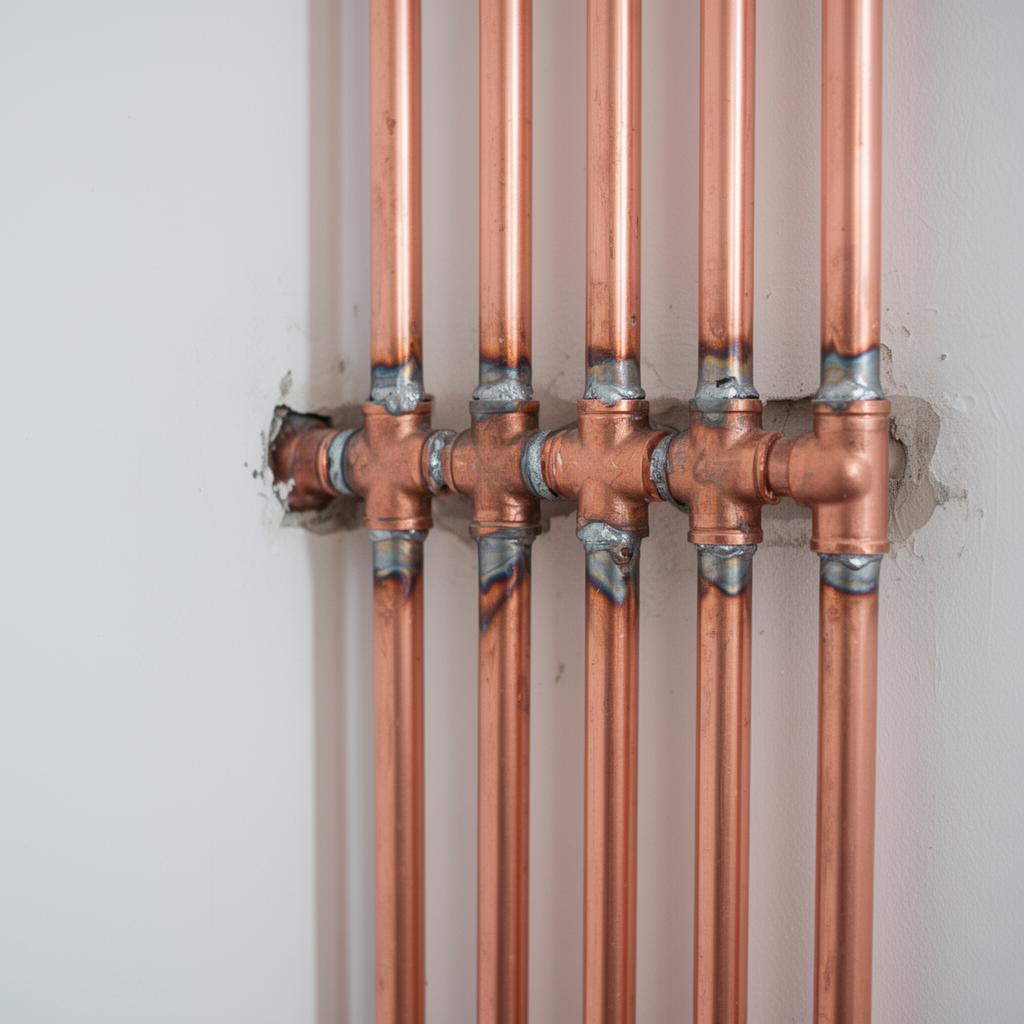
Solid stone or cob walls finished in lime plaster, common in the older parts of Dundry, behave very differently to modern plasterboard when a pipe run needs chasing in. Lime plaster is softer and more porous than gypsum, so cutting a neat, consistent chase without blowing the surface needs a slower hand and finer disc than a stud-wall job, and any repair has to be made good in a lime-based skim rather than modern filler, which can trap moisture behind it and cause the patch to fail. On solid stone we sometimes surface-mount pipework in painted conduit instead of chasing, particularly where the wall is a significant structural thickness and chasing would weaken it. Knowing which approach a wall needs before starting avoids expensive plaster damage.
How a condensing boiler recovers extra heat
A condensing boiler passes flue gases through a secondary heat exchanger before they leave the flue, extracting additional heat by condensing water vapour in the exhaust back into liquid, which is expelled as the mildly acidic condensate water down the drain. This is why every condensing boiler needs a condensate drainage route as part of its installation, unlike older non-condensing boilers, which simply vented hot dry gas straight out. The efficiency benefit only fully materialises when the boiler is actually condensing regularly, which needs a return water temperature low enough — generally below 55°C — for water vapour to condense in the first place. A condensing boiler run permanently at a high flow temperature can spend much of its time not actually condensing, which is one of the main reasons flow temperature settings matter as much as the boiler model chosen.
Other boiler services in Dundry
- Boiler Installation in DundryNew combi, system and regular boiler installations for gas and oil homes — fixed prices, manufacturer warranties.
- Gas Boiler Installation in DundryGas Safe registered installations and upgrades for mains gas homes across Bath, Radstock and Wells.
- Oil Boiler Installation in DundryOFTEC-trained oil boiler specialist for rural homes off the gas grid — tank and boiler replacements.
- Boiler Servicing in DundryAnnual boiler services to keep your warranty valid and your home safe, efficient and warm.
- Maintenance & Repair in DundryDiagnostics, repairs and breakdown call-outs for gas and oil boilers across BA and BS postcodes.
- Oil Boiler Servicing in DundryOFTEC registered annual servicing for oil boilers, including nozzle, electrode, filter and smoke test work on off grid homes.
- Oil Boiler Repairs in DundryOil boiler breakdown repairs across rural Somerset, from lockouts and sooting to pump, photocell and control faults.
- Oil Tank Replacement in DundryBunded oil tank replacement and relocation with base preparation, new supply line and OFTEC paperwork on completion.
New Worcester boiler with a 10 year guarantee*
Free no-obligation quotes for installation, servicing & repairs across BA & BS postcodes.