
Weak hot water flow from a combi boiler
If your shower has weakened gradually over a couple of years, the boiler is almost certainly fine — the plate heat exchanger inside it is silting up. If it dropped overnight, suspect a valve, filter or incoming main instead.
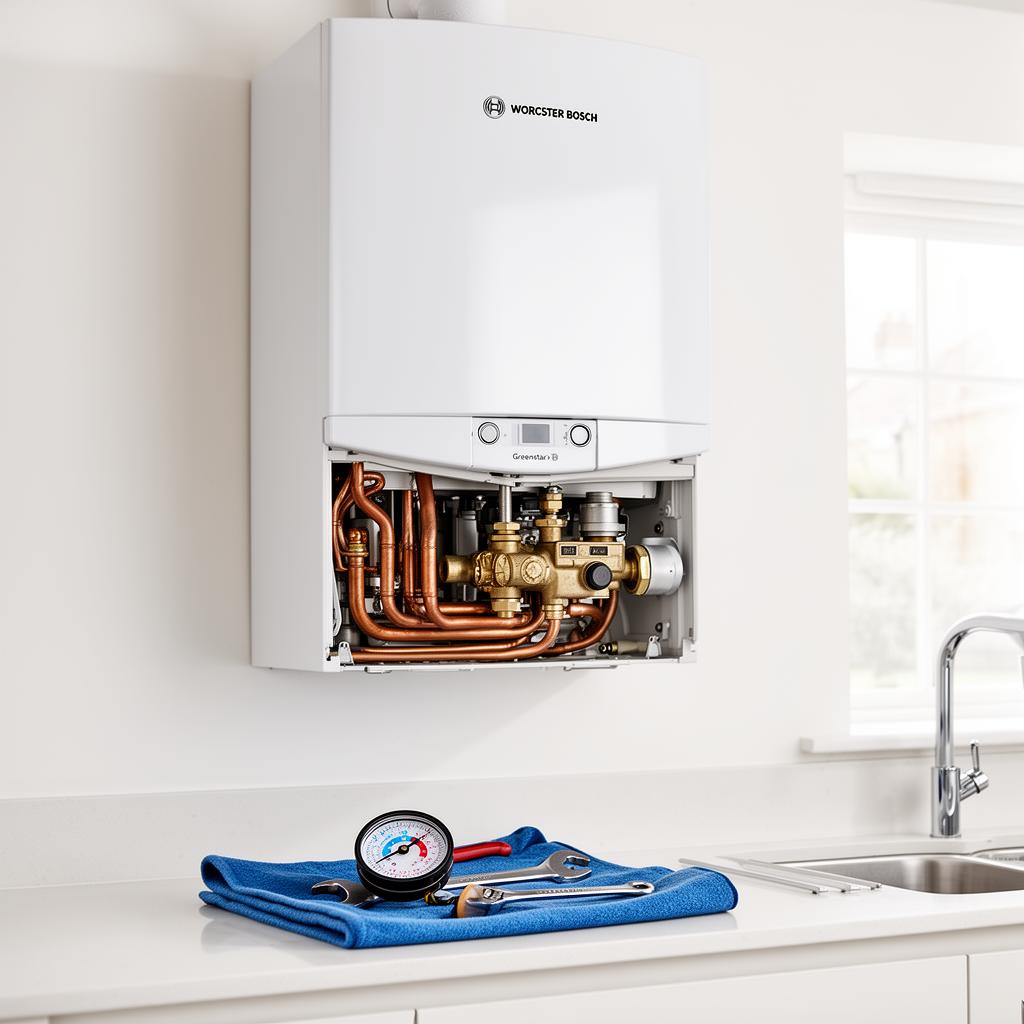
Gradual versus sudden
Much of the Mendip and Chew Valley supply is hard water, so scale forms steadily on the domestic side of a combi's plate exchanger. Flow drops, then temperature becomes erratic. A sudden loss usually traces to a partially closed isolation valve, a blocked inlet filter, or work on the street main. We test static and dynamic flow rate at the tap before opening the boiler.
What we check
- Measured flow rate in litres per minute at the outlet, cold and hot
- Inlet filter and isolation valves on the cold feed to the boiler
- Plate heat exchanger condition — descale or replace
- Diverter valve operation, which mimics the same symptoms
Is a scale reducer worth it?
In hard-water parts of BA3, BA4 and BS40 an inline scale reducer on the cold main is a cheap way to slow the problem. It won't remove existing scale, so it's fitted alongside a descale rather than instead of one.
Frequently asked
- Descale or replace the exchanger?
- Light scaling descales well. Heavy blockage is usually more economical to replace, and we'll show you the flow figures either way.
- Could the shower itself be the problem?
- Often, yes. We test at the bath tap too, because a limescaled shower head or cartridge is a much cheaper fix.
- Does this affect heating as well?
- Not usually — heating uses the primary side, which stays clean if the system is inhibited.
Test before you replace
A ten-minute flow-rate test tells you whether the fault is in the boiler, the plumbing or the tap. We won't quote for a new boiler over a hot-water complaint until that test is done.
Related solutions
Core services
Where we cover
New Worcester boiler with a 10 year guarantee*
Free no-obligation quotes for installation, servicing & repairs across BA & BS postcodes.